The best way to secure patio furniture from wind is to combine multiple methods: add weight at the base, use anti-slip pads on the legs, run ratchet straps or bungee cords through chair frames to anchor points, and store or close anything that catches air (umbrellas, cushions, covers) before a serious storm rolls in. No single trick works for every piece, so this guide walks you through exactly which method fits which furniture type, how to install each one without scratching or denting your pieces, and what to do when your current setup still fails.
How to Secure Patio Furniture From Wind: DIY Steps
Maren Grady
29 Apr 2026
Why wind is more dangerous than most people realize
Most homeowners think wind just nudges their chairs around. But at 35 to 45 mph, a lightweight resin chair becomes a fast-moving projectile, and an open patio umbrella can go fully airborne. The U.S. Consumer Product Safety Commission has issued direct safety warnings about unsecured umbrellas becoming airborne in gusts and causing lacerations or impalement injuries from the pole. That is not an exaggeration for effect. It is a documented hazard. Even a 20 mph gust, which barely registers as a windy day, can slide metal chairs across a deck, tip over a glass-top table, and send cushions into a neighbor's yard.
The furniture types that cause the most problems are the ones that feel stable but are not: folding chairs with open frames that catch wind like sails, tables with large flat surfaces and lightweight bases, and umbrellas left open when no one is sitting outside. If you have ever come home to a toppled table or gone outside after a storm to find chairs two yards away from where you left them, you already know how quickly things escalate. The goal here is to fix that before the next storm, not after.
Pick the right method for your furniture type
Different materials and furniture shapes need different solutions. Throwing a strap around a lightweight resin chair works fine. Doing the same thing to a wrought iron set that already weighs 80 pounds per chair is overkill, and a waste of time. Here is how to match the method to the piece.
| Furniture Type | Main Risk | Best Securing Method |
|---|---|---|
| Lightweight resin or plastic chairs | Flips and sails in even moderate wind | Anti-slip feet + stackable weight bags + strap through frame |
| Aluminum frame chairs and tables | Slides easily on smooth decks, tips in gusts | Rubber anti-slip pads + ground anchors or deck hooks + straps |
| Wrought iron / cast iron | Heavy but can still tip if top-heavy; glass tops are vulnerable | Rubber feet, table top clips, remove glass tops for major storms |
| Wood furniture (teak, eucalyptus, cedar) | Slides less but can tip; cushions catch wind | Anti-slip pads, remove cushions, tie legs to deck cleats if needed |
| Patio umbrellas (open) | Highest risk: airborne hazard in gusts over 25 mph | Close and strap shut, use weighted base (50+ lbs), add umbrella anchor stake |
| Cushions and covers | Blow off immediately in any real wind | Store indoors, use cover clips or bungee clips, weighted corners |
The single most important call you can make before a windstorm: close your umbrella. CPSC guidelines and most umbrella manufacturer manuals specifically direct homeowners to close and secure the umbrella during strong or gusting winds, even when the furniture around it is perfectly anchored. An open umbrella in a 40 mph gust is dangerous regardless of how heavy the base is. More on umbrella-specific steps below.
Weights, anchors, and anti-slip solutions
Anti-slip pads and rubber feet
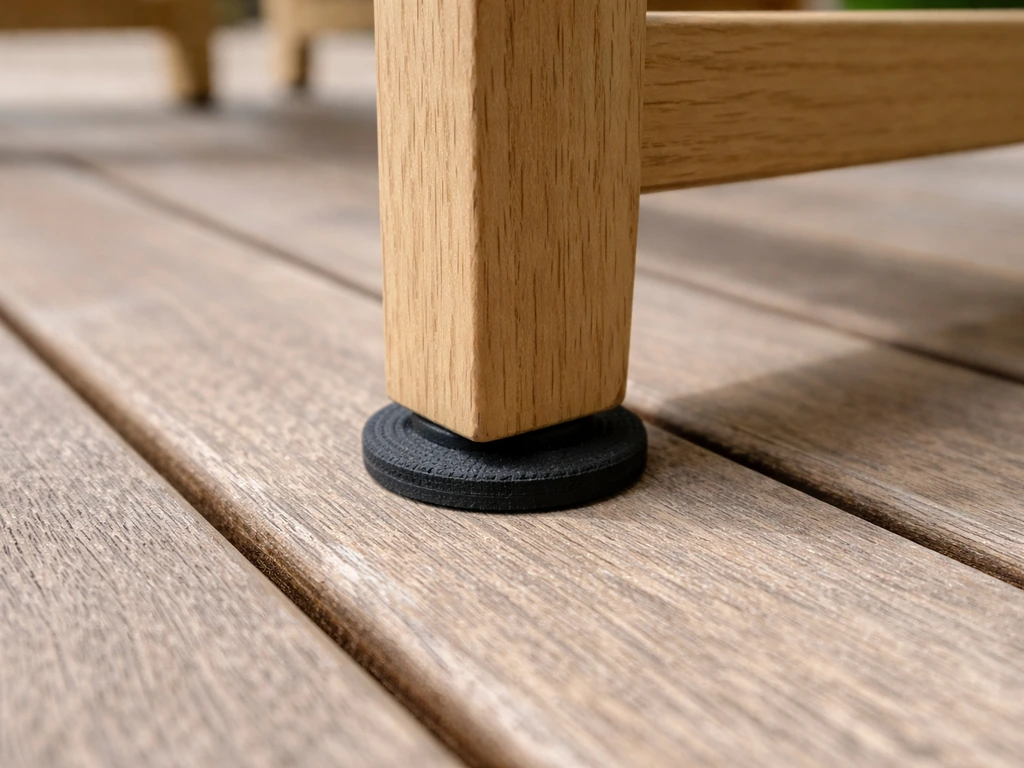
Start here because it is the cheapest fix and works surprisingly well on decks and patios. Rubber anti-slip pads go under each furniture leg and create friction between the leg and the surface. They cost about $5 to $15 for a set of 12 to 16 pads and take two minutes to apply. Look for pads specifically rated for outdoor use because indoor furniture pads break down fast in moisture. If your chair or table legs already have rubber feet, check them now. Worn, flattened rubber feet are almost as slippery as bare metal on a tile or composite deck. Replacement rubber tips (the kind that push onto the end of a chair leg) cost about $1 to $3 each at any hardware store. Swap them out before they cause a scratched deck or a toppled table.
Furniture weights and sandbags
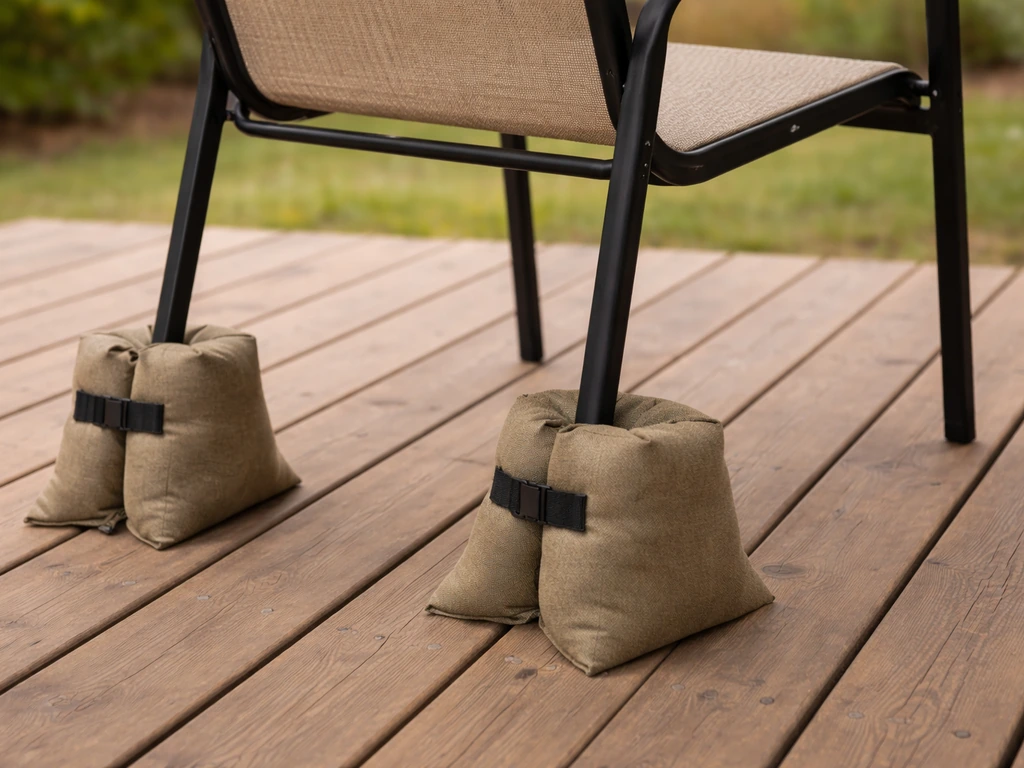
Weight is the most direct solution for lightweight furniture. Patio furniture weight bags are sold specifically for this purpose. They are flat, waterproof bags you fill with sand and drape over table bases or chair frames. A filled bag runs about 10 to 25 pounds each and costs $8 to $20. For a lightweight resin table, two bags on the base crossbar can make a real difference. Umbrella base weights are similar but designed as doughnut-shaped rings that stack around the umbrella pole. A compliant umbrella stand plus weighted rings should total at least 50 pounds for a standard 9-foot umbrella. If your stand feels wobbly with one hand, it is not heavy enough.
A budget alternative I have used: fill gallon zip-lock bags with play sand (about $4 per 50-lb bag at hardware stores), double-bag them, and tuck them inside the hollow base of plastic furniture or into fabric storage pockets on chair frames. It is not elegant but it works and costs almost nothing.
Ground anchors and deck hooks
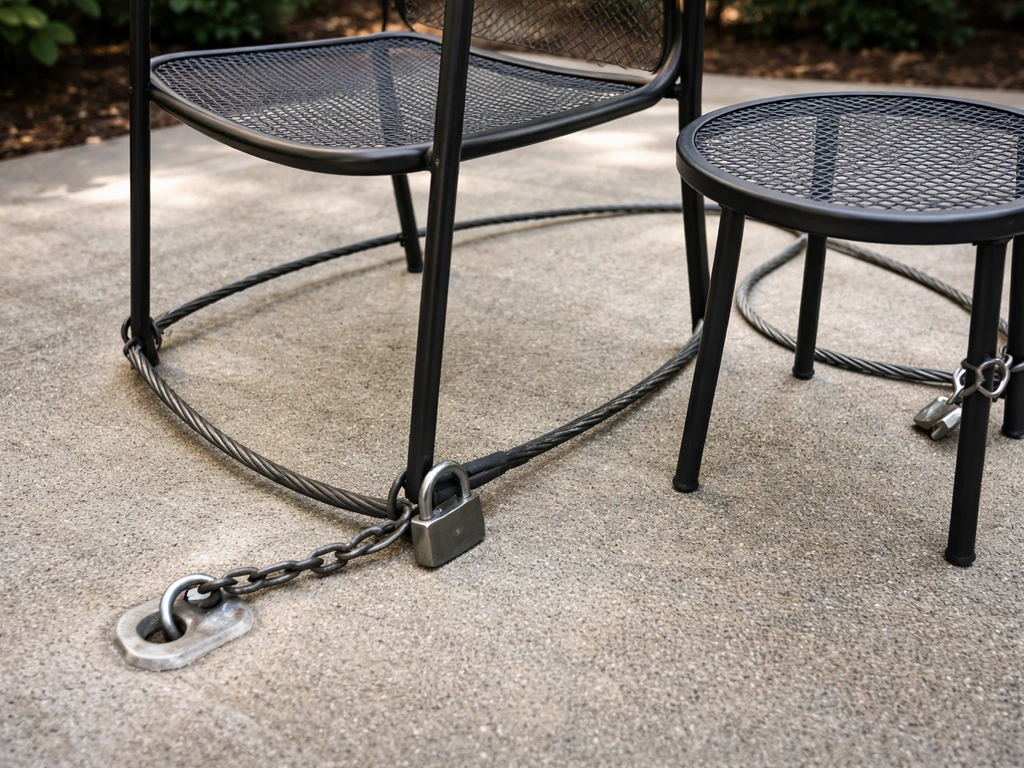
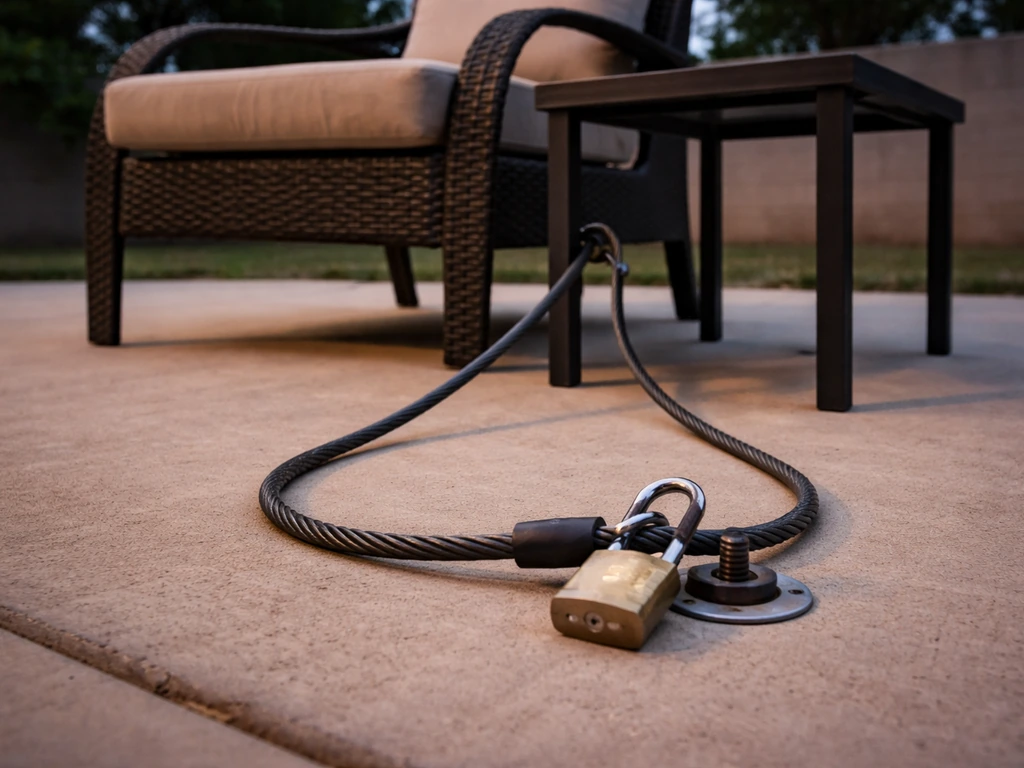
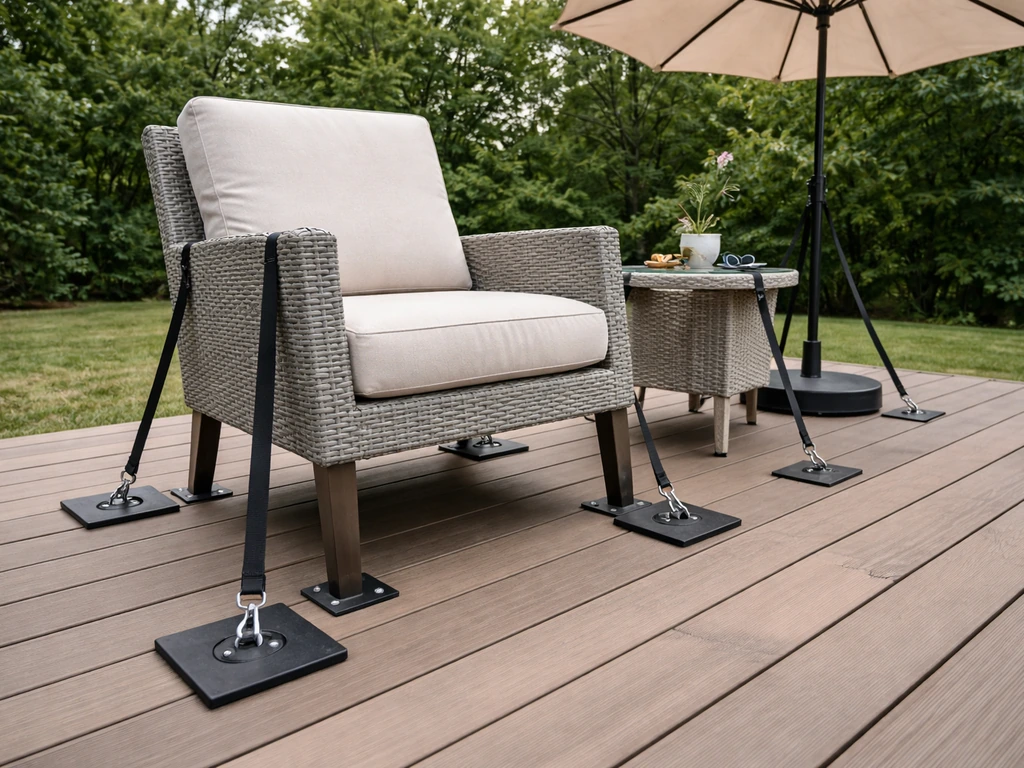
If you have a wood deck with visible joists or a concrete patio, you can install anchor points permanently. Deck hooks (also called deck tie-down rings or furniture anchors) screw into deck boards or concrete and give you a fixed point to run a strap or bungee cord through a chair or table leg. On concrete, use a concrete anchor bolt and a stainless steel ring. On wood decking, use a stainless wood screw hook rated for outdoor use. Installation takes about 10 minutes per anchor with a drill. Place them near where furniture legs sit naturally so your layout stays the same. The anchors are largely invisible when furniture is in place and you can leave them year-round.
If drilling into your deck is not an option (renters, or you just do not want to), patio furniture sandbag anchors that sit on the ground around the base of the legs are a non-invasive alternative. They are less bomb-proof but better than nothing, and you can move them around as needed.
How to use tie-downs and straps properly
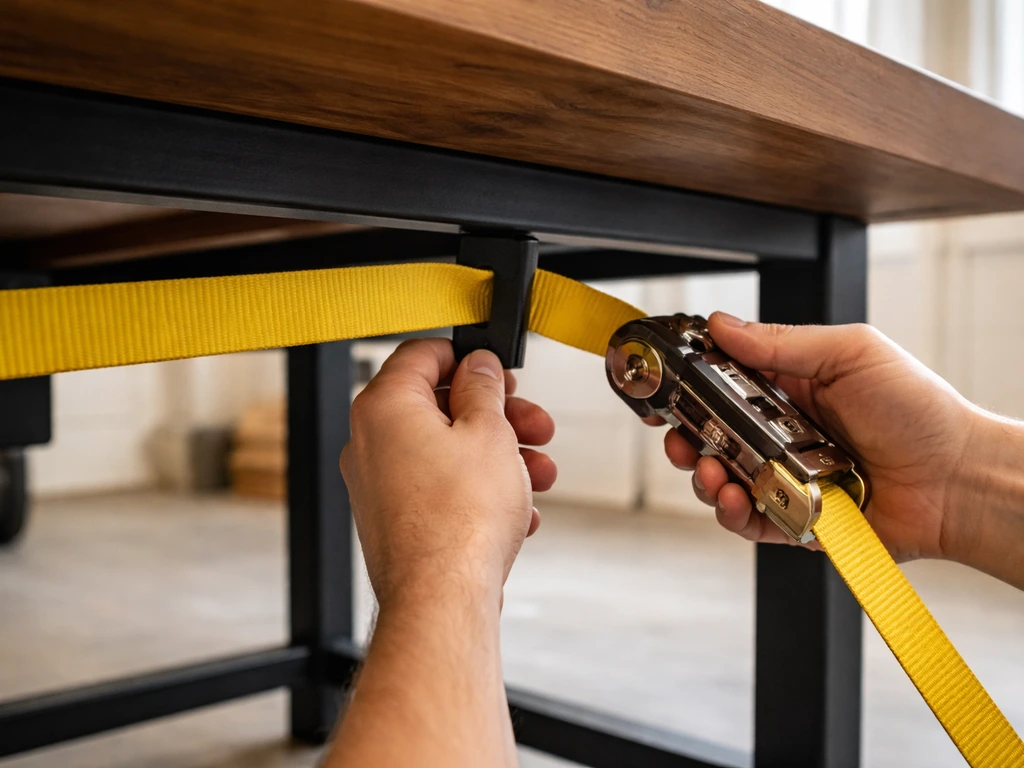
Straps and cords work best when you run them through or around a structural part of the furniture frame, not just over the surface. Here is exactly how to do it without scratching your pieces.
- Gather your materials: 1-inch wide ratchet straps (two to four per table, one to two per chair), foam pipe insulation or old towels (to protect finish), and the anchor points you installed or your deck railing posts.
- Wrap the strap hook or buckle in foam pipe insulation anywhere it will contact the furniture frame. This is the step most people skip, and it is why you end up with scratched metal or chipped paint.
- Thread the strap through or around a lower structural rail of the chair or table frame, not around a leg tip or decorative detail. Lower is better because it lowers the center of tipping force.
- Run the other end to your anchor point: a deck hook, a railing post, or a sandbag anchor on the ground.
- Tighten the strap until the furniture cannot slide or tip when you push it firmly with one hand. Firm but not over-tensioned: you should not see the frame flexing or bending under strap pressure.
- For chairs you are stacking (most resin and aluminum stackable chairs), strap the whole stack together as a single unit and anchor that. A stack of four chairs is far harder to move than four individual chairs tied separately.
- Check strap tension after the first windy night. Straps stretch slightly when wet and may need a small re-tighten.
Securing the umbrella specifically
This gets its own section because umbrellas are genuinely the most dangerous piece on a patio in high wind. The CPSC's safety standard for compliant anchor systems is designed to hold in winds up to 30 mph when properly installed, but that number assumes the umbrella is closed and the anchor is correctly seated. An open umbrella catches so much wind force that no base weight alone is reliable above 20 to 25 mph. The rule here is simple: if you see a storm forecast or feel sustained gusts, close the umbrella, wrap the fabric tight against the frame, and use the tie strap (most umbrellas include one) to keep it furled. Then run a separate bungee cord or strap around the folded umbrella and its pole to hold everything down. If your umbrella does not have a table-mount hole, a heavy umbrella base (minimum 50 pounds) with an additional ground stake anchor through the base is the setup you need.
Cushions and covers in wind
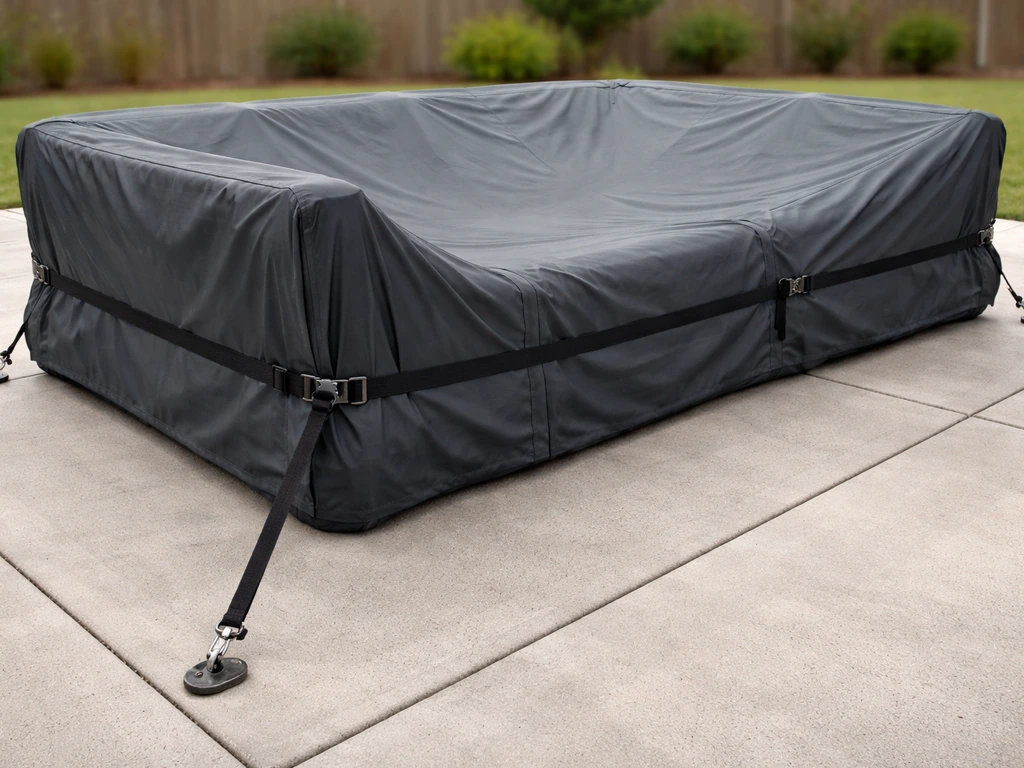
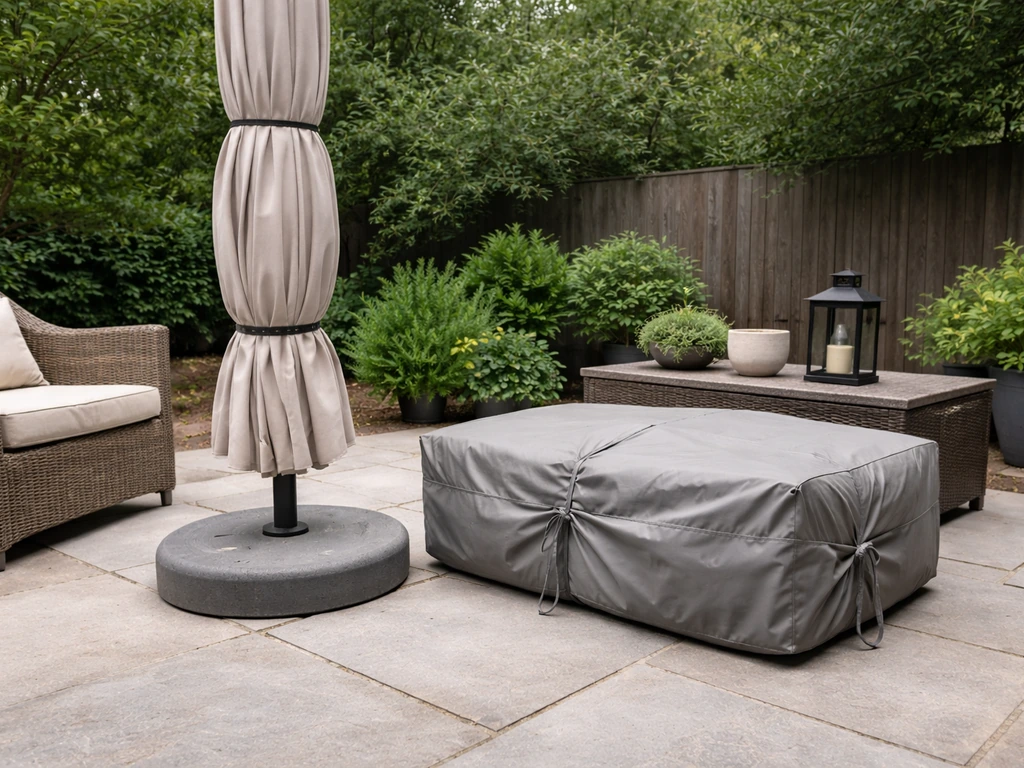
Cushions are the easiest problem to solve and the one most people ignore until they are fishing a cushion out of a flowerbed. The quickest solution: bring cushions inside when wind picks up. If you want to leave them out, furniture cover clips (small plastic bungee hooks designed to grip cover edges) can also grip cushion edges to the chair frame. For furniture covers, dedicated cover clips or stretch cords with hooks keep the cover from billowing and tearing in wind. Secure at a minimum of four corners and, on large tables, add two mid-side clips as well. Covers that trap air underneath and balloon up will rip or pull off within minutes in sustained wind, so always use covers that have air vents, or leave a small gap at the base.
Keep furniture in good shape while it is secured for the season
Securing furniture from wind is not a one-time job. If furniture sits anchored through a wet or humid season, you can create new problems: rust on metal frames, mold on cushion fabric, and moisture trapped under covers that rots wood joints. Here is how to avoid all of that.
Before you strap things down for an extended period
- Clean all metal frames with a mild soap and water solution, then dry them completely. Any standing moisture under a strap or pad creates a rust pocket on steel or aluminum.
- Apply a thin coat of car wax or outdoor metal protectant spray to aluminum and steel frames. This takes 20 minutes and adds months of rust protection.
- For wood furniture, apply a fresh coat of teak oil or outdoor sealant if it has been more than one season. Secured furniture that sits in rain without sealant will crack and gray out fast.
- Remove cushions and store them in a dry indoor space or in a breathable outdoor storage bin. If they must stay outside, use breathable covers, not solid plastic bags, which trap moisture and grow mold within days.
- Rinse cushion fabric before storage and let it dry completely in the sun. A mild bleach-and-water solution (one tablespoon per quart of water) kills mold spores before they have a chance to establish.
Covering furniture that stays outside
Furniture covers are great at blocking UV and rain but terrible at breathability if you pick the wrong kind. Look for covers with air vents built into the sides. If yours do not have vents, prop a small spacer (a folded piece of foam or a zip-tie loop) under the cover hem at two opposite corners to let air circulate. This prevents the mildew smell and surface mold that builds up under sealed covers, especially on wood and resin surfaces. The added benefit: a vented, clipped-down cover is also much harder for wind to rip off than a sealed one that balloons with trapped air. If you want to go further on covers, securing them tightly with straps is its own sub-topic worth exploring.
When your furniture still moves: troubleshooting weak points
If you have already done the basics and things still shift, the problem is almost always one of three things: the anchor point is too high on the furniture, the rubber feet are worn flat, or there are not enough attachment points. Here is how to diagnose each one.
- Furniture tips but does not slide: Your strap is attached too high on the frame, allowing the chair or table to lever up before the strap catches. Move the attachment point lower, ideally at the bottom crossbar or foot rail.
- Furniture slides even with straps: The straps are not anchored to a fixed point, only to another piece of furniture. Both pieces move together. Add a true anchor point to your deck or floor.
- Rubber pads keep falling off: You are using indoor adhesive-backed pads in outdoor humidity. Switch to screw-on rubber feet or outdoor-rated press-fit rubber tips. No adhesive required.
- Umbrella base rocks side to side: The pole fits loosely in the base. Wrap the pole base with one to two layers of marine foam tape until it fits snugly without wobbling. Check that your total base weight is at or above 50 pounds.
- Folding chairs unfold in wind: The fold joint is loose or the locking pin is worn. Apply a zip-tie through the fold joint hole to keep it locked in the open (seated) position during storage, or replace the locking pin.
- Castors roll even with locks set: Castor locks on most budget patio furniture wear out quickly. Replace them with locking castors rated for outdoor use, or remove the castors entirely and substitute rubber furniture cups on the leg ends.
- Straps leave marks on the furniture finish: You skipped the foam padding on the hooks and buckles. Wrap all metal hardware contact points in foam pipe insulation cut to size and secured with tape.
One thing I learned the hard way: checking your setup after the first serious storm tells you exactly what to fix. Walk outside after a 30 mph wind event and see what moved. That is your weak point. Tighten it, lower it, or add an anchor before the next one.
Pre-storm checklist: run through this before wind hits
Keep this list somewhere you can grab it fast when a storm forecast comes in. It takes about 15 to 20 minutes to run through the whole thing.
- Close and strap down all patio umbrellas. No exceptions, even for brief storms. Wrap the fabric tight and use the furling strap plus a secondary bungee.
- Bring all cushions indoors or into a covered, ventilated bin.
- Remove glass table tops if the storm forecast exceeds 40 mph winds. Lean them face-first against an indoor wall, not flat on the floor.
- Check that all rubber feet and anti-slip pads are still in place and not cracked or flattened.
- Stack lightweight chairs and strap the stack to a fixed anchor point.
- Tighten all existing strap tie-downs and verify each strap is threaded through a low structural rail, not a decorative edge.
- Confirm umbrella base weight is at least 50 pounds. Add weight bags if it is lighter.
- Clip down or remove any furniture covers that are not vented, so they do not balloon and tear in the wind.
- Walk around and push every anchored piece firmly with both hands. If it wobbles more than an inch in any direction, tighten the strap or add a second anchor before you go back inside.
- Check again after the storm. Note anything that moved or shifted and fix the weak point before the next storm.
Patio furniture securing is one of those projects that feels tedious until the first time a storm proves you right. If you are also worried about theft, see how to secure patio furniture from theft for extra locking and anti-tamper ideas that complement windproofing. If you need a step-by-step approach, start with the basics of how to lock up patio furniture before wind or storms arrive. If you are specifically preparing for a hurricane, the same principles apply but you should go a step further with weight, tie-downs, and anchoring points rated for high gusts how to lock up patio furniture. If you also need to cover outdoor furniture, follow these steps on how to secure a tarp over patio furniture so wind cannot lift or tear it how to lock up patio furniture. A $15 set of rubber pads, a couple of deck hooks, and two ratchet straps will protect pieces that cost hundreds or thousands of dollars to replace. Do it once, dial in the weak points after the first real test, and you will barely think about it again.
FAQ
Can I just use one bungee cord or one strap to stop all patio furniture from sliding?
Usually not. A single attachment often leaves the “lift” or “twist” direction unrestrained, so chairs still rotate or tables still scoot. Use at least two restraint points per piece (for example, one on each side of a chair frame, or two straps crossing the base for a table), and route the cord through a structural part or around a crossbar, not just over the tabletop or seat surface.
What should I do if my patio furniture is on uneven pavers or a deck with gaps?
Anti-slip pads and sandbags work less reliably when legs do not all sit flat. Add a thin outdoor rubber shim under legs that wobble, then re-check after the first windy afternoon. If you can anchor, place tie-down rings close to where the legs naturally land so the strap pulls straight down and doesn’t introduce sideways force.
Do anti-slip pads work on all materials, like smooth metal legs on composite decking?
They help most when the leg has clean contact and the pad is outdoor-rated. If legs are wet, oxidized, or have hard plastic feet, pads may slip. Clean the leg ends, replace flattened feet, and choose pads labeled for outdoor use, not indoor floor protection, because moisture breaks down indoor compounds faster.
How heavy do weight bags need to be for chairs, not just tables?
For chairs, focus on preventing rotation and lifting, not only sliding. Two moderate bags placed low and positioned to straddle the chair base or lower frame often work better than one heavy bag higher up. If the chair has a hollow frame, avoid stuffing weight too high where the cord can lever it off balance, and re-test after a gusty day.
Is it better to anchor furniture to the deck or to place anchors on the ground?
Deck or concrete anchors are stronger because they prevent both sliding and “walking.” Ground sandbag anchors are less bomb-proof and can shift, but they are convenient for renters and can be set quickly without drilling. If you expect sustained gusts or live in a hurricane-prone area, prioritize permanent anchor points or freestanding umbrella stakes plus additional tie-downs.
Can I use my patio furniture cover in windy weather, or will it make things worse?
It can make things worse if the cover balloons. Use vented covers when possible, and keep them clipped down at the corners. If your cover traps air and inflates, swap to a vented model or prop a small gap at two opposite corners so wind cannot build pressure under the fabric.
How do I stop cushions and lightweight items from blowing out from under a closed cover?
Bring cushions inside when wind increases, or secure them before covering. If you leave them out, use cover clips that grip both the cover edge and the cushion area, and add mid-side clips on large pieces (tables or wide sets). Don’t rely on the cover alone for cushions, because loose items turn into wind catchers underneath.
What’s the fastest way to diagnose why my furniture still moved after I secured it?
After a serious wind event, compare the final positions to where each leg or base originally sat. If one side moved first, you likely have an anchor point that is too high or not symmetrical, or worn feet on that side. Tighten straps, replace rubber tips, and add an extra attachment point at the weak corner instead of increasing only the top weight.
How tight should I make straps and cords so I do not damage furniture finishes?
Snug enough that the furniture cannot rack, but not so tight that you deform frames or crush fabric. Use padding where straps contact painted metal or delicate rails, and route straps around frame members instead of through furniture panels. Re-check after the first storm because cords can loosen slightly as material compresses.
For umbrellas, what if my umbrella base is already heavy but it still moves in gusts?
In many setups the base weight alone is not enough because the umbrella tilts and catches wind. Confirm the umbrella is fully closed, then wrap fabric tight against the frame and secure it with the built-in tie strap. Add a separate restraint around the folded umbrella and pole, and if there is no table-mount hole, use a heavy stand plus a ground stake anchor through the base.
Do I need to remove and store furniture after every windy day?
Not always, but you should treat “moderate-to-gusting” days as a trigger to do the low-effort items. At minimum, close umbrellas, bring loose cushions inside, and check that cover clips are intact before the worst gusts. For frequent storms, keep a small kit (pads, clips, spare straps, and tie-down rings) near your patio door so you can re-secure quickly.
Where can I find attachment points for furniture that has no obvious anchor holes or crossbars?
Look for structural rails under seats, the lower frame near leg junctions, or built-in metal rings on the chair base. If there are no safe structural points, consider adding external straps through the chair’s frame openings where they contact metal rather than plastic. If the piece is lightweight and smooth, anchor the legs with deck rings plus ratchet straps so force is applied at the base level.