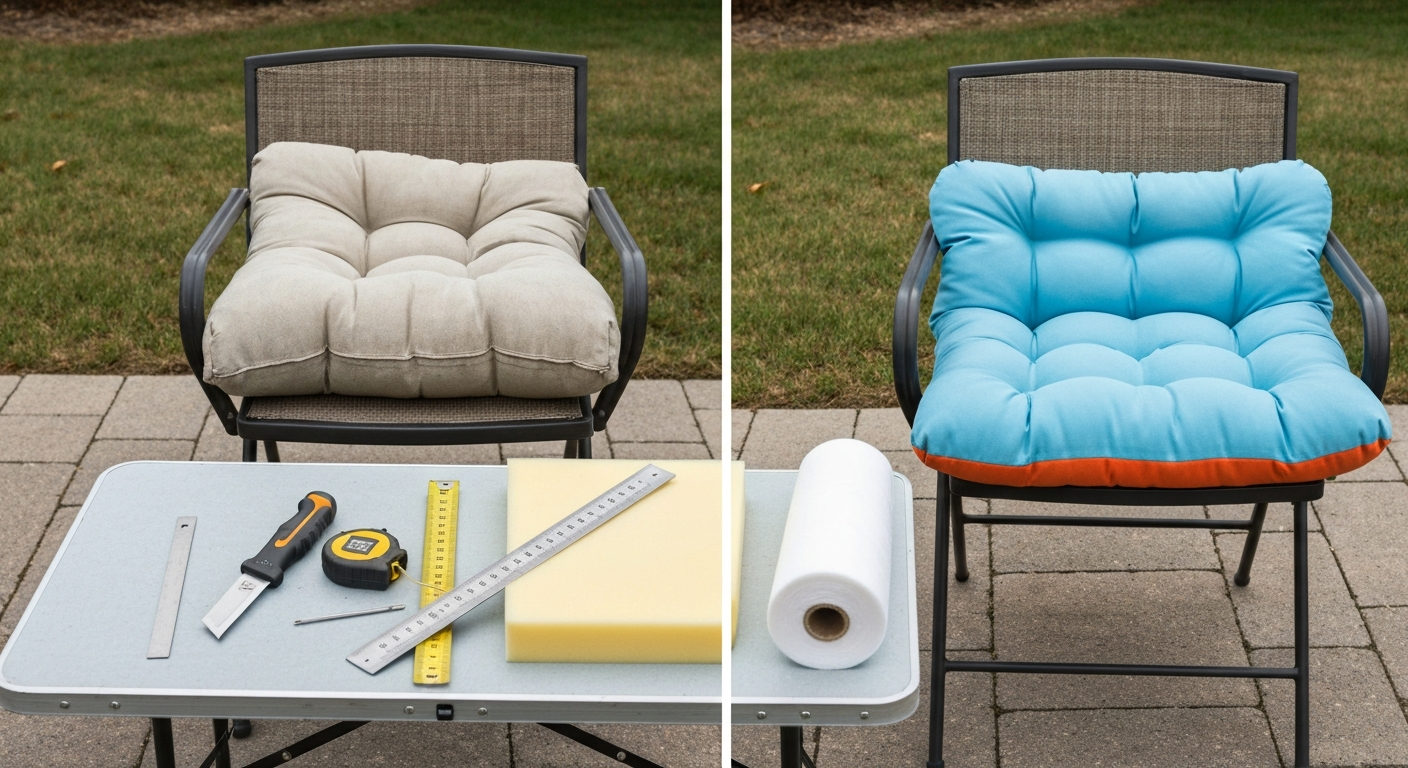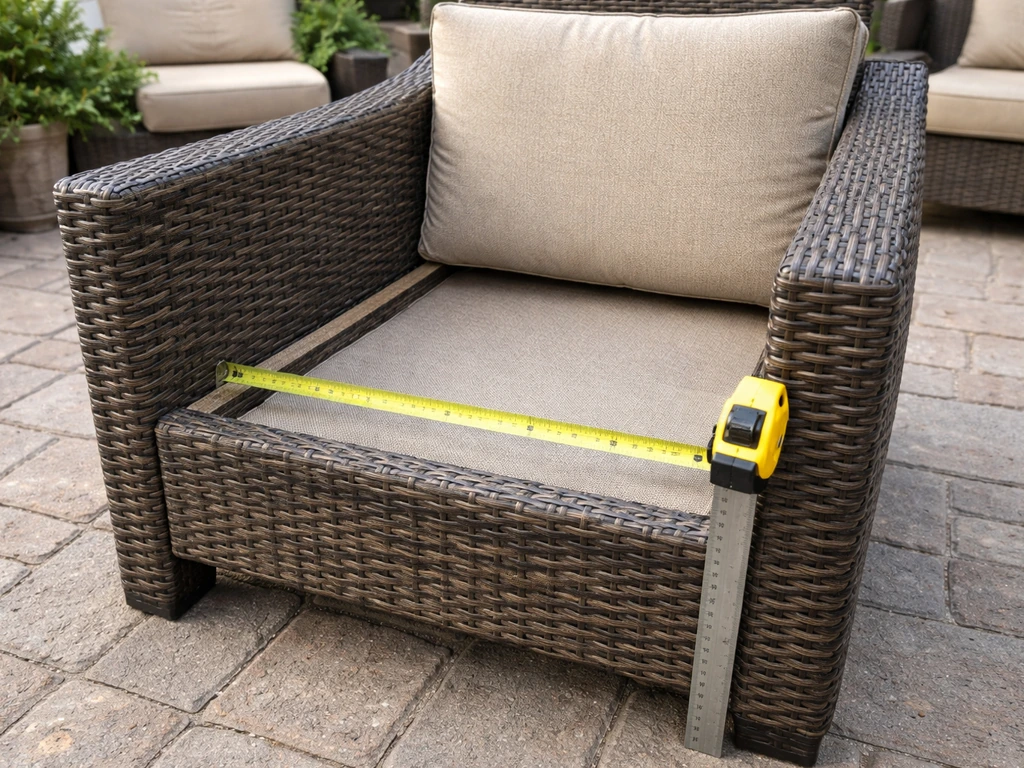
For a standard box cushion on a 54-inch-wide fabric bolt, a single 20"×20"×4" seat cushion needs roughly 1.5 yards of fabric. A full set of four matching cushions on the same bolt runs about 4.5 to 5 yards once you account for seams, piping, and a little breathing room. That number shifts depending on your cushion shape, the fabric width, and whether your print has a pattern repeat, but those figures give you a working starting point before you even pick up a tape measure.
How Much Fabric Do I Need to Recover Patio Cushions?
Maren Grady
15 Jul 2026
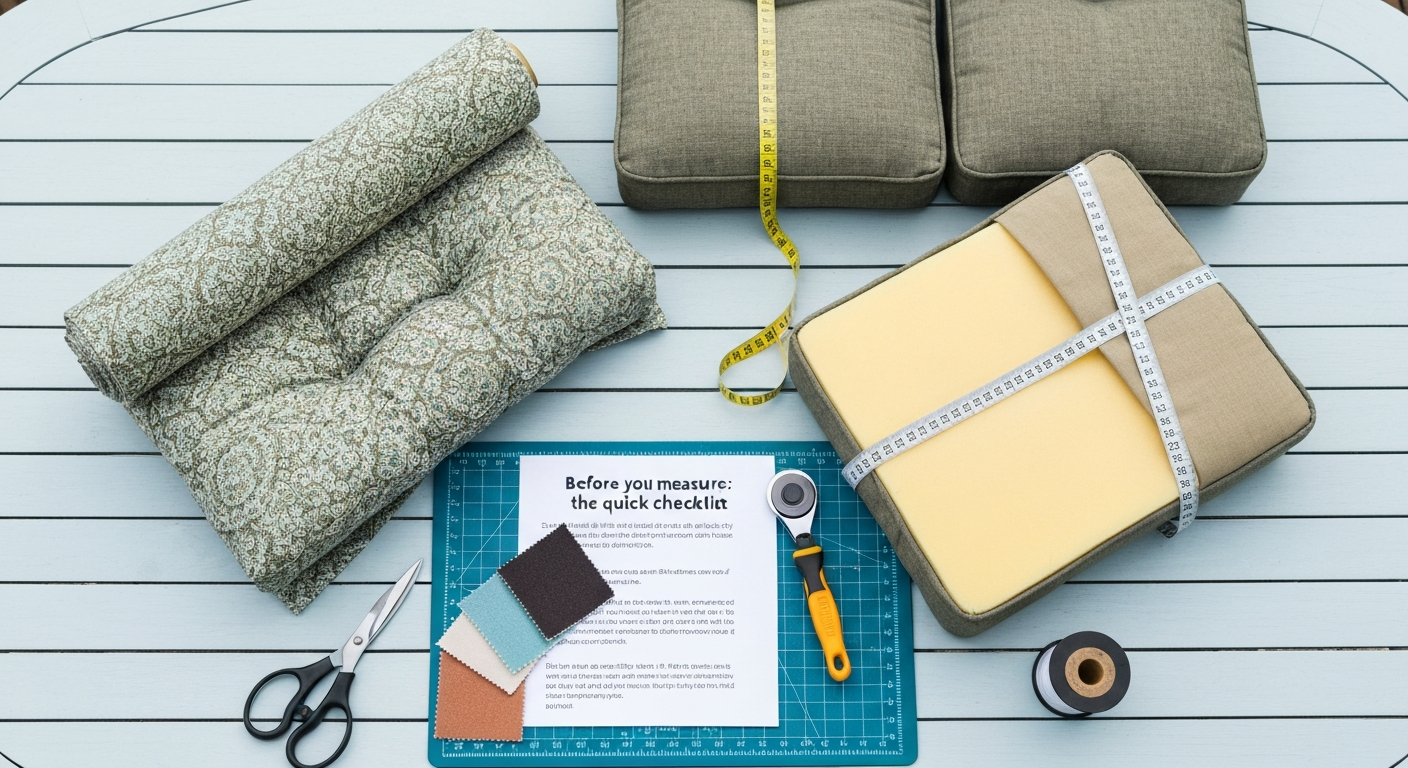
This guide is written for homeowners who want to recover their patio cushions themselves without overbuying fabric or ending up short halfway through a project. I'll walk you through measuring every common cushion shape, show you the formulas to convert those measurements into actual yards, and give you sample yardage tables you can use as a sanity check. Whether you're tackling a single lounge chair cushion or an entire dining set, you'll leave here knowing exactly what to order.
Before you measure: the quick checklist
I've started cushion projects without doing this and ended up making three trips to the fabric store. Don't be me. Before you calculate anything, gather the following information and write it down on paper or in a note on your phone. Having all of it in one place saves you from guessing mid-calculation.
- Cushion shape: box, knife-edge, round/disc, bolster, or semicircle
- Finished length (L) in inches, measured seam-to-seam or foam-insert edge-to-edge
- Finished width (W) in inches, measured the same way
- Finished thickness (T), also called side height or depth, in inches
- Diameter (D) for round cushions, or radius if that's what your tape shows
- Number of cushions to recover
- Whether you want piping/welt cord on the seams (yes or no changes the math)
- Whether your chosen fabric has a pattern repeat or directional nap (check the bolt label or product page)
- The fabric width of your chosen bolt: 44–45", 54–60", or wide-format ~112"
- Whether you need a zipper closure (adds a small amount to the boxing strip calculation)
If you still have the old cushion covers, measure them before you cut them apart. A seam-to-seam measurement of the existing cover is more accurate than measuring a foam insert that has compressed or shifted over the years. If the foam itself is what you're working from, measuring the patio cushions accurately is covered in more detail in the companion guide on how to measure patio cushions. For detailed steps on measuring for covers specifically, see the companion guide on how to measure patio furniture covers.
Tools and supplies to have ready
You don't need a professional upholstery shop to do this well. Here's everything I keep on the table when I start a cushion project:
- Flexible tape measure (at least 60" long — a standard dressmaker's tape works fine)
- Rigid metal ruler or yardstick for straight-line measurements on flat panels
- Marking chalk or a fabric marker (not a ballpoint pen — it bleeds through outdoor fabrics)
- Fabric scissors dedicated only to fabric (cutting paper with them ruins the blade)
- Rotary cutter and self-healing cutting mat for long straight cuts
- Straight pins or basting clips to hold panels before sewing
- Heavy-duty upholstery thread or UV-resistant polyester thread rated for outdoor use
- A sewing machine with a size 16 or 18 needle for heavier outdoor fabrics
- Welt/piping cord in 1/4" to 3/8" diameter for standard cushion piping
- Zipper in the correct length for your boxing strip (measure the back edge of the cushion to size)
- A calculator or smartphone — the math is simple but easy to scramble in your head
- Graph paper or a free online cutting-layout planner to sketch your panel arrangement
On budget: welt cord is cheap (a 50-yard spool runs about $6–$10 at most fabric stores). Don't skip it even if your original cushions didn't have piping, it adds structural definition to the seam and hides minor stitching imperfections, which is genuinely helpful when you're learning. Zippers for cushions are almost always available at thrift stores or fabric store remnant bins for almost nothing.
Picking the right outdoor fabric
Not all fabric is made for the outdoors, and using the wrong type is one of the most expensive mistakes a first-timer makes. Indoor upholstery fabric fades, mildews, and breaks down within a single season outside. Here's a quick comparison of the outdoor fabric types worth your time:
| Fabric Type | Typical Width | Key Strengths | Watch Out For | Approximate Cost/Yard |
|---|---|---|---|---|
| Solution-dyed acrylic (e.g. Sunbrella) | 54" (137 cm) | Fade-resistant, mold/mildew resistant, cleanable, long lifespan (5–10+ years) | Higher upfront cost; heavier to sew | $20–$40+ |
| Polyester outdoor upholstery | 54"–60" | More affordable, wide color range, decent fade resistance | Not as durable as solution-dyed acrylic; may fade after 2–3 seasons in full sun | $8–$20 |
| Marine/canvas duck cloth | 44"–60" | Very durable, water-resistant, affordable | Stiff; can mildew if not treated; limited patterns | $6–$15 |
| Olefin/polypropylene | 54"–60" | Colorfast, stain-resistant, budget-friendly | Lower abrasion resistance than acrylic | $7–$18 |
| Treated outdoor cotton/canvas | 44"–45" | Soft hand, natural look, inexpensive | Requires regular re-treatment; fades and mildews faster than synthetics | $5–$12 |
My honest recommendation: if you're going to put in the time to sew these covers, spend the extra money on solution-dyed acrylic fabric like Sunbrella (which comes on a 54-inch bolt almost universally). Product spec sheets for Capra Indigo 145600-0002 – Outdoor Fabrics (Sunbrella product page) list Width: 54". The covers will outlast any budget polyester option by years. If you're on a tight budget, treated polyester outdoor upholstery is a solid middle ground. Whatever you choose, check that it's rated for outdoor/UV use before you buy. Care notes: most quality outdoor fabrics can be spot-cleaned with mild soap and water, and many can be hand-washed or run through a front-load washer on cold. Always air dry. Avoid bleach on solution-dyed acrylics unless the manufacturer specifically allows it.
The allowances that trip everyone up
Here's where I messed up on my first set of cushions: I measured the foam, calculated the panels, ordered fabric, and forgot that every seam eats into the material. I came up about half a yard short. The allowances below are non-negotiable, build them into every calculation.
Seam allowance
Add 1/2" (12.7 mm) per seam for standard outdoor upholstery work. Common practical guidance is to allow 1/2" (12.7 mm) to 5/8" (15.9 mm) seam allowance per seam for cushion covers; heavier or bulkier upholstery work may use 3/4"–1" allowances for more robust finishing What is Seam Allowance? The Invisible Foundation of Sewing (SewingBible). Heavier fabrics like canvas duck can use 3/4" to 1" for a more robust seam. Remember that every seam has two sides, so a top panel joined to a boxing strip uses 1/2" from the top panel AND 1/2" from the boxing strip. In practice, I add 1" to each finished panel dimension (1/2" per side) to get the cut dimension.
Piping and welt cord
For each piping seam, you'll cut fabric strips to encase the cord. For standard 1/4" to 3/8" upholstery welt cord, cut your piping strips about 1" to 1.25" wide (enough to fold the fabric around the cord and still leave a 1/2" seam allowance on each side). The length of piping strip you need equals the cushion's full perimeter plus 2 to 4 inches for joining. For a 20"×20" box cushion that's (2×20 + 2×20) = 80" of piping per seam line, and you usually pipe two seams (top and bottom), so about 160" total per cushion. Multiply by your number of cushions, add those inches up, and figure out how many 1"–1.25" strips of that length fit across your fabric width. That's how many additional linear inches of fabric you need for piping alone. It's usually modest, often less than 1/4 yard for a single cushion, but it adds up across a full set.
Zippers
A zipper is set into the back boxing strip. The standard approach is to split the back boxing strip into two pieces and sew the zipper between them, which adds one extra seam allowance to that strip's height (another 1/2" to 1"). Plan your back boxing strip as: (finished cushion thickness + 1" for seam allowances + 1" for zipper seam allowance).
Pattern repeat and nap
This is the allowance most DIYers ignore until it's too late. If your fabric has a repeating print (say the design tiles every 9 inches vertically), you have to round every cut length up to the next full repeat to keep the pattern aligned across cushions. A 9-inch repeat on a 21-inch cut length means you're actually cutting 27-inch lengths (the next full multiple of 9 above 21). That wastes 6 inches per panel. Across 8 panels for a 4-cushion set, you've lost 48 inches, which is more than a yard on a 54-inch-wide bolt. As a general rule: add 10–30% extra yardage for patterned fabrics, with larger repeats demanding the higher end. Directional fabrics (nap or one-way prints) carry the same penalty because you can't rotate pieces to nest them efficiently, budget 15–30% additional yardage for those.
Tufting
Tufted cushions gather fabric at each button point, which consumes more material than a flat cover. Add 10–15% to your top and bottom panel dimensions to account for this draw-in. If you're tufting deeply, add a full inch per tuft location to each panel dimension.
How to measure and calculate yardage for box cushions
Box cushions are the most common patio cushion shape, they have a flat top, a flat bottom, and a straight vertical boxing strip around the sides. Dining chair seats, lounge chair cushions, and bench cushions are almost always box-style.
Step-by-step measuring
- Measure the finished length (L) of the cushion in inches (front edge to back edge, seam to seam)
- Measure the finished width (W) in inches (left to right, seam to seam)
- Measure the finished thickness (T) — the side height — in inches (top seam to bottom seam)
Panel breakdown and cut dimensions
A box cushion cover has five pieces: one top panel, one bottom panel, two side boxing strips, and one front/back boxing strip (or a continuous boxing strip). Here's how to calculate each cut dimension, using a seam allowance (SA) of 1/2" per seam:
- Top panel cut size: (L + 1") × (W + 1") — adds 1/2" SA on each of the 4 edges
- Bottom panel cut size: (L + 1") × (W + 1") — same as top
- Boxing strip cut length: 2×(L + W) + 4" for overlap and joining
- Boxing strip cut height: T + 1" for top and bottom SA + 1" extra if installing a zipper = T + 2" (with zipper) or T + 1" (without)
Converting to yards: the formula
Once you have your cut dimensions, figure out how many of each panel fit across your fabric width, then calculate how many inches of fabric length you need to cut all of them. Divide that total inches by 36 to get yards, and always round up to the nearest 1/4 or 1/2 yard.
The formula: Number of strips across bolt = ceil(panelwidth ÷ fabricwidth). Linear inches needed = numberofstrips × cutlength. Yards = linearinches ÷ 36 (round up).
Worked example: 20"×20"×4" seat cushion on 54" fabric
- Top panel cut: 21" × 21". Two top/bottom panels fit side by side on 54" fabric (21 + 21 = 42", under 54"). You need one 21" length to cut both. With 4 cushions, that's 4 lengths of 21" = 84" = 2.33 yards for top/bottom panels.
- Boxing strip cut: length = 2×(20+20)+4" = 84". Height = 4+2" = 6" (with zipper). Two 84"×6" strips fit side by side on 54" fabric (6+6=12"). You need 4 strips (one per cushion), so 2 lengths of 84" = 168" = 4.67 yards. BUT: most 54" fabric won't fit 84" across the width, so you run the boxing strip along the length of the bolt. One strip = 84" long × 6" wide. For 4 cushions, total strip length = 4×84" = 336". At 54" wide, you fit 54÷6 = 9 strips per length; with 4 strips needed, you only need 84" of fabric length for the boxing. That's 2.33 yards.
- Total raw panels: 2.33 + 2.33 ≈ 4.7 yards for 4 cushions (no piping yet).
- Piping strips: perimeter per cushion = 80". Two piped seams = 160" per cushion × 4 cushions = 640" of 1.25" wide strips. At 54" wide, you get 43 strips of 54" length across the bolt, so you need ceil(640÷54) ≈ 12 strips × 1.25" wide. That's 12 × 1.25" = 15" of fabric length = 0.42 yards.
- Grand total before waste buffer: ≈ 5.1 yards. Add 10% for a plain fabric: order 5.5 to 6 yards.
Box cushion yardage quick-reference table (54" fabric, plain fabric, with piping)
| Cushion Size (L × W × T) | Yards per Cushion | Yards for 2 Cushions | Yards for 4 Cushions | Yards for 6 Cushions |
|---|---|---|---|---|
| 18" × 18" × 3" | 1.25 | 2.25 | 4.25 | 6.25 |
| 20" × 20" × 4" | 1.5 | 2.75 | 5.0 | 7.25 |
| 24" × 24" × 5" | 1.75 | 3.25 | 6.0 | 8.75 |
| 48" × 20" × 4" (bench) | 2.25 | 4.0 | 7.5 | 11.0 |
| 24" × 24" × 4" (back cushion, 2" T) | 1.25 | 2.25 | 4.25 | 6.25 |
These figures include a 10% waste buffer and are based on 54-inch-wide fabric with 1/2" seam allowances and standard piping on the top and bottom seams. Add 15–30% if you're working with a patterned or directional fabric.
How to measure and calculate yardage for knife-edge cushions
Knife-edge cushions have no boxing strip at all, the top and bottom panels are sewn directly together at the outer edge, tapering to a thin seam around the perimeter. They're common on back cushions, throw-style outdoor seat pads, and decorative accent pieces. Because there's no separate boxing strip, the calculation is simpler, but the top and bottom panels need to be slightly larger than the finished cushion to account for the taper and seam.
Step-by-step measuring
- Measure the finished length (L) of the cushion at its widest/longest point
- Measure the finished width (W) at its widest point
- Note the finished thickness (T) — knife-edge cushions are usually 1.5" to 3" thick, and the thickness is achieved by the foam, not a boxing strip
Panel breakdown and cut dimensions
- Top panel cut size: (L + 1") × (W + 1") — standard 1/2" SA per edge
- Bottom panel cut size: (L + 1") × (W + 1") — same
- No boxing strip needed — the seam runs around the perimeter
- If you want a hidden zipper on one edge, add 1" to that edge's dimension on both top and bottom panels
Converting to yards
Knife-edge cushions are the most fabric-efficient shape because you're only cutting two panels. On a 54-inch-wide bolt, two 21"×21" panels (for a 20"×20" cushion) fit side by side with room to spare, meaning you only need about 21" of fabric length per cushion, just under 0.6 yards. For four cushions, that's roughly 2.5 yards including a 10% buffer. Here's a quick reference:
| Cushion Size (L × W) | Yards per Cushion | Yards for 2 Cushions | Yards for 4 Cushions | Yards for 6 Cushions |
|---|---|---|---|---|
| 18" × 18" | 0.65 | 1.25 | 2.5 | 3.5 |
| 20" × 20" | 0.65 | 1.25 | 2.5 | 3.5 |
| 24" × 24" | 0.75 | 1.5 | 3.0 | 4.5 |
| 24" × 18" | 0.65 | 1.25 | 2.5 | 3.5 |
| 48" × 20" (long back cushion) | 1.5 | 2.75 | 5.0 | 7.25 |
Piping on a knife-edge cushion runs along the single perimeter seam. Perimeter for a 20"×20" = 80". Cut 1.25"-wide strips totaling 80" per cushion (plus 3" overlap). For four cushions that's about 332" of strip, which fits on 54"-wide fabric in 7 strips of 1.25" width, requiring only about 48" (1.33 yards) of fabric length, but since you're already cutting panels from that same yardage, the piping strips usually nest in the leftover space between panels at no additional cost in yardage.
How to measure and calculate yardage for round cushions
Round disc cushions show up on bistro chairs, accent ottomans, and outdoor footstools. They look tricky but the math is straightforward once you know the circumference formula. Each round cushion needs two circular panels (top and bottom) plus a rectangular boxing strip whose length equals the cushion's circumference.
Step-by-step measuring
- Measure the finished diameter (D) of the cushion in inches — measure across the widest point through the center
- If you only have a circumference measurement (from a measuring tape around the edge), convert: D = circumference ÷ 3.1416
- Measure the finished thickness (T) — the side height — in inches
Panel breakdown and cut dimensions
- Top circle cut size: cut from a square of side (D + 1"), then trace and cut the circle — the extra 1" gives you seam allowance all around
- Bottom circle cut size: same as top — square of side (D + 1")
- Boxing strip cut length: (π × D) + 4" for overlap and joining = (3.1416 × D) + 4"
- Boxing strip cut height: T + 1" (no zipper) or T + 2" (with zipper)
Worked example: 20" diameter × 4" thick round cushion on 54" fabric
- Top/bottom circles: cut from 21"×21" squares. Two circles (one top, one bottom) fit side by side on 54" fabric (21+21=42"). You cut both from a single 21" length of fabric.
- Circumference = 3.1416 × 20" = 62.83". Boxing strip length = 62.83 + 4" = 66.83", round to 67".
- Boxing strip height = 4" + 2" (zipper) = 6". You can fit 54÷6 = 9 strips across the 54" bolt width. One strip is 67" long, so you need 67" of fabric length for the boxing strip.
- Total length needed: 21" (circles) + 67" (boxing) = 88". That's 88÷36 = 2.44 yards — round up to 2.5 yards for a single cushion.
- For 4 round cushions: multiply panels. Circles: 4 cushions × 21" = 84" (but you fit 2 circles per 21" length, so 2 lengths = 42"). Boxing: 4 × 67" = 268"; at 9 strips per bolt width, you need ceil(4÷9) = 1 pass × 67" = 67" of length. Total ≈ 42 + 67 = 109", divide by 36 = 3.03 yards. Add 10% buffer = 3.35 yards. Order 3.5 yards.
Round cushion yardage quick-reference table (54" fabric, plain, with piping)
| Diameter × Thickness | Yards per Cushion | Yards for 2 Cushions | Yards for 4 Cushions |
|---|---|---|---|
| 16" × 3" | 1.25 | 2.0 | 3.5 |
| 18" × 4" | 1.5 | 2.5 | 4.0 |
| 20" × 4" | 1.75 | 3.0 | 4.5 |
| 24" × 5" | 2.25 | 3.75 | 6.5 |
One important note on round cushions: cutting circles from square panels means you'll have curved scrap triangles left over. These aren't usable for panels, but they're great for cutting piping strips, so plan to use that off-cut for your welt cord and you won't need to add separate piping yardage.
Fabric width matters more than you think
The three fabric widths you'll realistically encounter are 44–45" (utility cotton and canvas), 54–60" (most outdoor upholstery fabric including Sunbrella at 54"), and very-wide formats around 106–112" used for awnings and industrial applications. Wider fabric means fewer seams in your boxing strips and often fewer total yards needed, because more panels nest side by side on each fabric length. Here's how the same 20"×20"×4" box cushion set of 4 changes across widths:
| Fabric Width | Yards for 4 Box Cushions (20"×20"×4") | Notes |
|---|---|---|
| 44–45" | 6.5–7.0 yards | Panels barely fit two across; boxing strips may need joining seams |
| 54" | 5.0–5.5 yards | Most efficient for standard seat cushions; two panels fit comfortably |
| 60" | 4.5–5.0 yards | Extra width helps with larger cushions and bench-length boxing strips |
| 112" | 2.5–3.0 yards | Overkill for cushions but great for bench cushions or chaise covers with zero seams in the boxing strip |
Cutting layout tips to minimize waste
Once you know your cut dimensions, the smartest move is to sketch a cutting layout before you touch the fabric. Draw a rectangle representing your bolt width and plan where each panel goes. Here are the habits that save the most material:
- Place top and bottom panels side by side across the width first — they're usually the largest pieces and dictate how much length you need
- Run boxing strips along the length of the bolt (lengthwise grain), not across it — outdoor upholstery fabric is more stable on the lengthwise grain
- Nest piping strips in the gaps between larger panels — you almost never need a separate length of fabric just for piping strips
- Cut all pieces for all cushions from the same fabric orientation if you have a directional print — rotating a piece 90 degrees will make the stripe or pattern look wrong on the finished cushion
- Mark all pieces with chalk before cutting any of them — you'll see layout conflicts before they happen
- Leave 1" of selvage on each side unused — selvage edges are tighter-woven and may pucker when sewn
Metric conversions for non-imperial measurements
If you're working in centimeters or ordering from an international supplier, here are the key conversions you'll need. Note that 1 inch = 25.4 mm exactly, and 1 yard = 0.9144 meters exactly (so 1 yard ≈ 91.4 cm).
| Imperial | Metric Equivalent |
|---|---|
| 1 inch | 25.4 mm / 2.54 cm |
| 1 foot (12 inches) | 30.48 cm |
| 1 yard (36 inches) | 91.44 cm / 0.914 m |
| 44 inches (bolt width) | 111.8 cm |
| 54 inches (bolt width) | 137.2 cm |
| 60 inches (bolt width) | 152.4 cm |
| 1/2" seam allowance | 12.7 mm |
| 1" seam allowance | 25.4 mm |
Ordering tips: swatches, extra yardage, and where to buy
Always order a swatch before you commit to several yards of outdoor upholstery fabric. Most online fabric retailers offer 4"×4" or 6"×6" swatches for a dollar or two (sometimes free), and it's the only reliable way to check color accuracy on your monitor and feel the weight of the material. Color on screens varies wildly, what looks like navy blue online can arrive looking almost black.
Add at least 10% to your calculated yardage before placing your order, and 15–30% if your fabric has a pattern repeat or directional print. Most fabric stores sell in 1/4-yard increments online and in 1/8-yard increments at physical stores, so round up to the nearest sensible increment. It's far cheaper to have half a yard left over than to re-order and discover the dye lot is slightly different, outdoor fabric dye lots vary noticeably between production runs.
- Local fabric stores: best for handling material in person, getting immediate help on yardage, and avoiding shipping costs on heavy fabric
- Online specialty retailers (e.g., Sailrite, Online Fabric Store, Fabric.com): wider selection of outdoor-rated fabrics, often cheaper per yard, good for large orders
- Direct from manufacturer sites (Sunbrella authorized dealers): ensures authentic product and accurate spec information
- Remnant bins (in-store or online): great for single cushions or small sets — you can often find 3–5 yard remnants of quality outdoor fabric at 30–50% off
- Thrift stores and estate sales: occasionally yield patio furniture cushion covers in good fabric that can be repurposed — check stitching and UV degradation before buying
What to do once you have the fabric
With your fabric cut and your panels organized, the actual sewing goes quickly, especially if you've prepped well. If the foam inside your existing cushions is also shot, you'll want to address that before sewing the new covers closed. Restuffing and replacing cushion foam is covered in depth in the companion guide on how to restuff patio cushions. If the frames or cushions themselves need structural repairs first, the guide on how to fix patio cushions walks through the most common issues. See the step-by-step guide on how to fix patio cushions for common repairs, foam replacement, and frame fixes. And if you started this project because your cushions had unwanted guests, it's worth checking out the guide on bugs in patio cushions before you seal fresh foam inside a new cover.
Once the project is done, the recovered cushions will last significantly longer if you store them properly off-season and protect them from prolonged exposure to standing water. If you ever find yourself with old covers or foam you've replaced, the guide on what to do with old patio cushions has practical ideas for repurposing or disposing of them responsibly rather than sending everything straight to the landfill.
The measuring and math in this guide works for any cushion, any shape, and any fabric width. Take your time on the layout sketch before you cut, add that extra 10%, and order your swatch first. Once you've done one set of cushions, the second set takes half the time. For another relevant comparison, see how to measure patio cushions.
FAQ
How do I measure a patio cushion before calculating fabric yardage?
Measure finished dimensions (seam-to-seam) if you have the cover; otherwise measure foam insert. For rectangular/box (knife-edge): record Length (L), Width (W), and Thickness/Side height (H). For round discs: Diameter (D) and H. For bolsters: Length (L) and Diameter (D) (or radius). For semicircles: Straight edge length (flat L), radius (R) if curved edge, and H. Write measurements in inches and millimetres. Note whether fabric is directional (nap) or has a repeat/pattern.
What seam allowances and extra allowances should I add before calculating yardage?
Standard seam allowance: 1/2" (12.7 mm) to 5/8" (15.9 mm) per seam; use 3/4"–1" for heavy upholstery. Piping/welt: allow extra for the cord wrap and a 2–4" overlap join. Zippers: add ~1" extra where zipper will sit. Tufting: add allowance per tuft (typical +1–2" per tuft axis) and extra for anchor channels. Pattern repeat/nap: add 10–30% depending on repeat size and whether fabric is directional. Cutting mistakes/contingency: add 5–15% depending on project complexity.
What is the general panel formula for a rectangular (box/knife-edge) cushion?
Panels needed: Top = L × W, Bottom = L × W, Boxing strip = length 2×(L+W) and height = H + (top seam allowance + bottom seam allowance) + piping allowance if any. So cut a boxing strip of width = H + seams (+ piping) and length = 2×(L+W). Convert that strip layout to bolt yardage by determining how many strips fit across fabric width and calculating linear length.
What formula do I use for a round (disc) cushion?
Top and bottom: circles of diameter D (cut from squares D×D or use a circle template). Boxing (side) strip length = π×D (use π≈3.1416). Boxing strip height = H + seam allowances (+ piping). Convert the boxing strip into straight strips across fabric width and compute linear yardage as with rectangles.
How do I calculate for a bolster (cylinder) cushion?
You need two end circles (diameter D) and one long boxing strip: length = circumference = π×D, height = H (which equals D for a full round end-to-end) — for bolsters, H is the diameter thickness; add seam allowances. If the bolster is a flat-ended cylinder, you can often cut ends from remnant squares of size D×D and the boxing strip from the bolt.
How do I translate panel inches into yards by fabric width? (stepwise formula)
1) Convert all piece widths (across the bolt) and lengths (along the bolt) to inches. 2) For each type of strip/panel, determine how many strips of that width fit across the fabric usable width (fabric_width_inches). 3) Total linear inches required along bolt = sum of (ceil(number_of_strips_needed) × required_length_in_inches). 4) Convert to yards: total_inches ÷ 36 = yards. Round up to vendor-sold increments and then add your extra allowance percent for pattern/nap/mistakes.