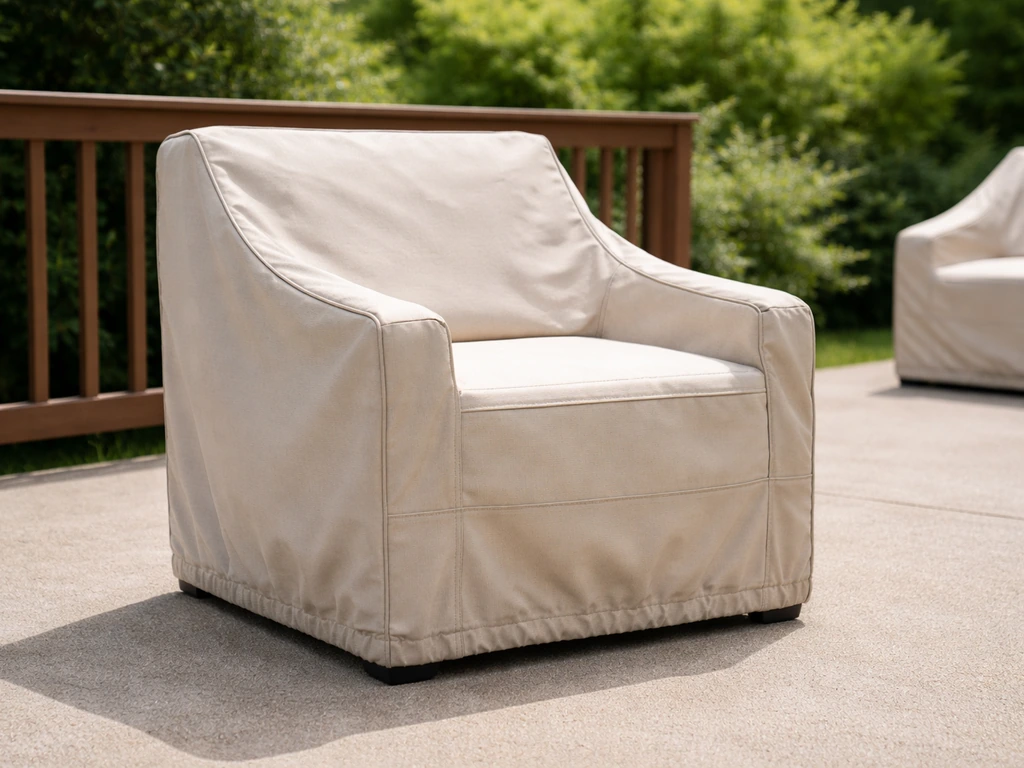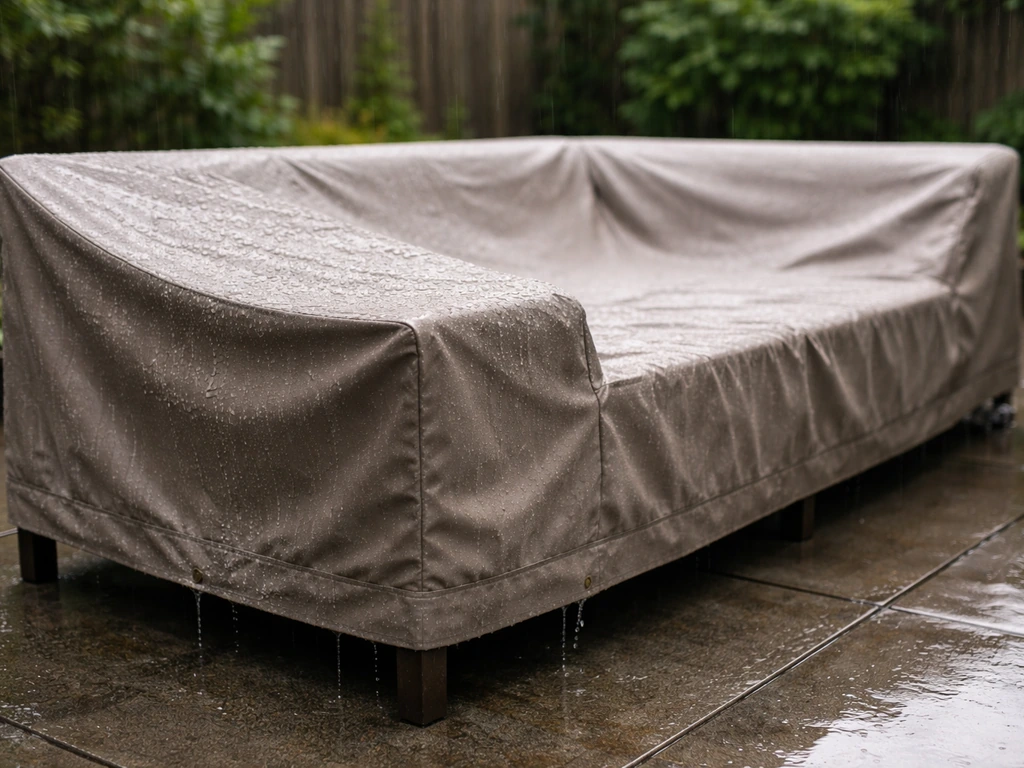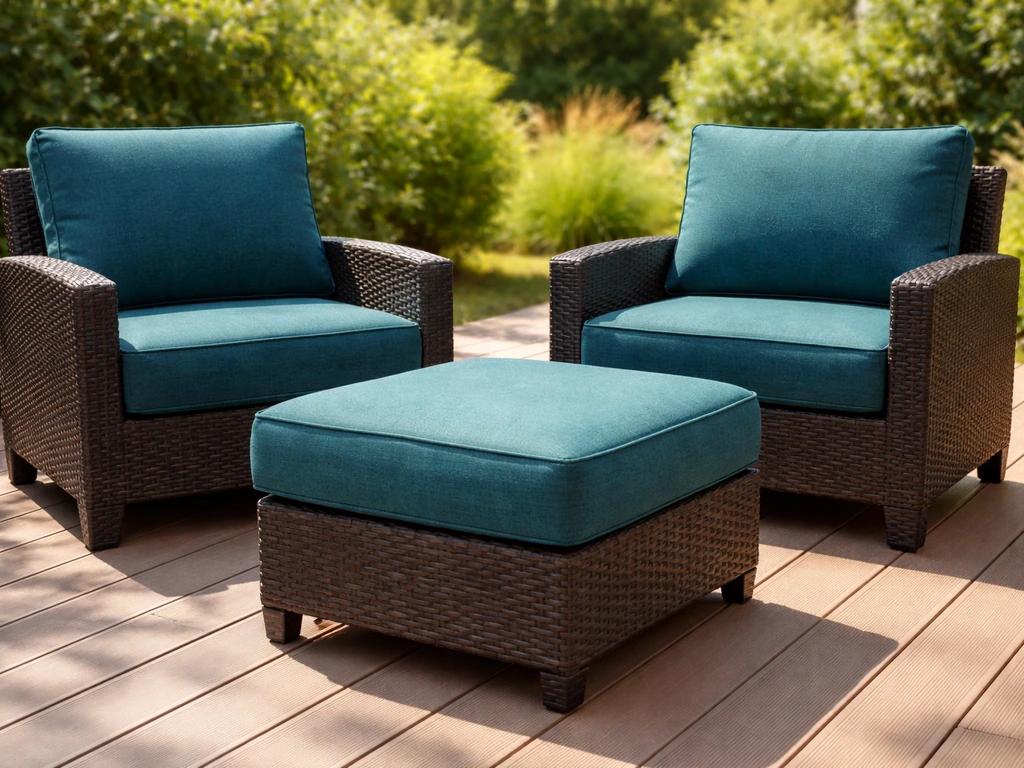
To buy patio furniture covers that actually last, you need three numbers (length, width, and height for each piece), a clear sense of your climate's worst-case weather, and a fabric rated for at least 10,000 mm hydrostatic head if you get heavy rain. Beyond that, it comes down to fit style, closures, and where you shop. This guide walks you through every step, including when it makes more sense to skip the store and sew your own.
How to Buy Patio Furniture Covers: Buy vs Make, Fit & Care
Maren Grady
17 Jul 2026
Why the right cover makes a real difference
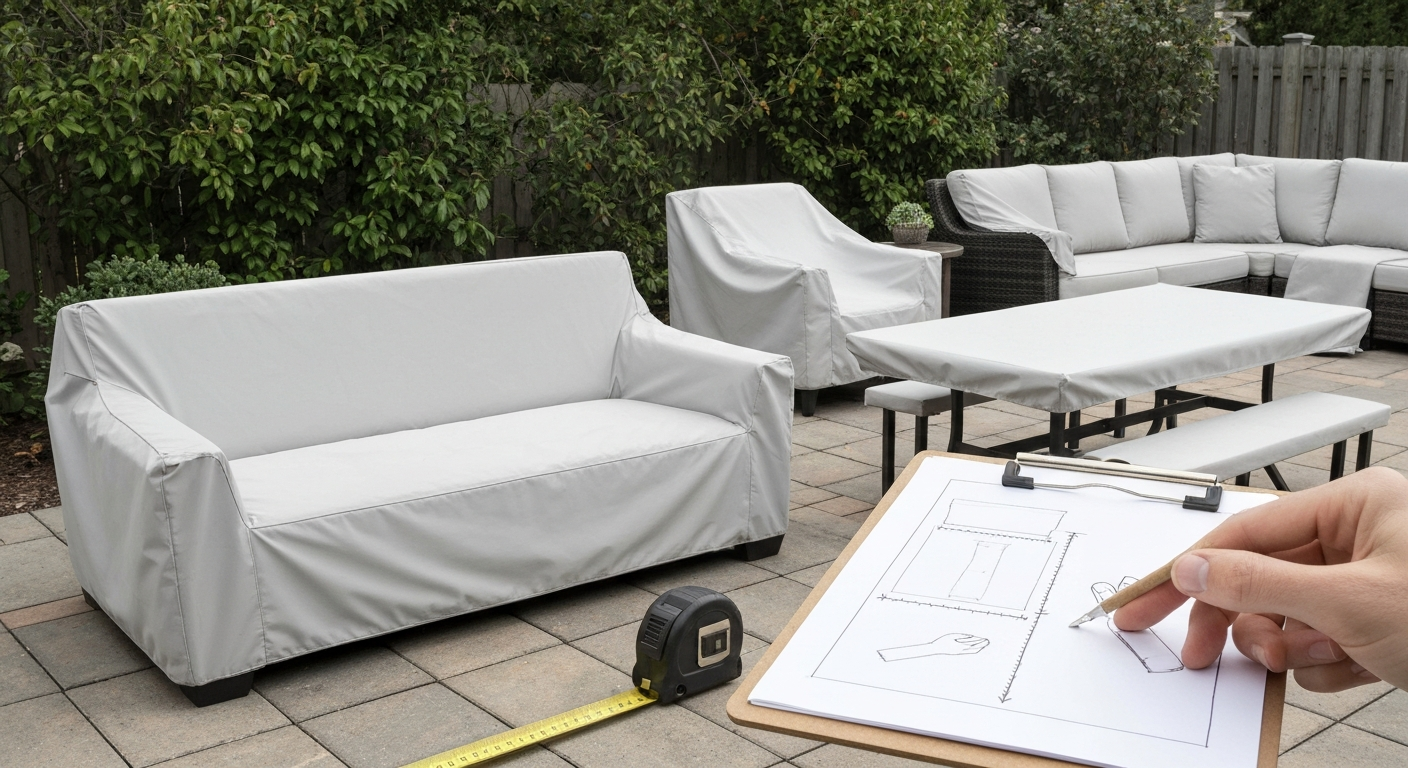
I've replaced patio furniture I shouldn't have had to replace, simply because I used flimsy covers or none at all. UV exposure breaks down cushion foam and fades frames in a single season. Pooling water rots wood joints, corrodes steel hardware, and grows mildew into foam that you can never fully clean out. A quality cover, fitted properly and made from the right material, can add years to a set that would otherwise need replacing every three to four years. That's not marketing, it's the difference between a $40 investment and a $600 furniture replacement.
This guide is built around the actual buying process: how to measure, what specs matter, what features to insist on, and where to find covers at every price point. If you're also curious about making your own covers instead of buying them, I'll point you in that direction too, because sometimes DIY really is the better call.
Buy vs. make: how to decide before you spend anything
This is the first question to settle, because it changes everything downstream. Buying is faster and often fine for standard furniture shapes. Making your own cover gives you a perfect fit on odd-sized or custom pieces, more fabric choices, and usually a lower material cost per cover if you're doing multiple pieces. But sewing heavy outdoor fabric is genuinely hard work and requires either a heavy-duty sewing machine or a no-sew approach with seam tape and grommets.
Here's how I'd frame the decision. If your furniture is a standard shape (a 60-inch two-seat sofa, a 48-inch round table, a standard dining chair), buying is almost certainly easier and will cost about the same or less once you factor in your time. If your piece is an L-shaped sectional, an unusual height, or something you built yourself, custom or DIY is worth the effort. Same goes if you want a specific fabric like Sunbrella and can't find it pre-made in your size.
- Your furniture is a standard shape and size: buy a store-bought cover
- You want a premium fabric like solution-dyed acrylic but can't find it ready-made in your size: DIY or custom order
- You have an L-shaped sectional, corner piece, or custom-built furniture: DIY or have a canvas shop make it
- You need covers for five or more pieces and want uniform fabric: buy in a set for the discount
- You're on a tight budget and have time to sew: DIY with polyester canvas or coated ripstop will cost less per cover
- You want no-sew construction: workable for simple shapes using iron-on seam tape and grommets
- You want exact color matching to cushions or an umbrella: custom order or DIY is the only reliable path
Where to shop, which brands to look at, and what things cost
The patio cover market is split pretty clearly between budget-tier covers at big-box stores, mid-range options at online marketplaces, and premium or custom covers from specialty suppliers. Knowing which tier you're shopping helps you set realistic expectations.
Big-box and home improvement stores
Home Depot, Lowe's, and Walmart carry covers in the $20 to $80 range for most individual pieces. These are typically made from laminated polyester or light PVC-coated fabric. They're serviceable for mild climates and seasonal use, but the seams are usually stitched (not welded or taped), and the elastic hems lose tension after one or two winters. If you're covering furniture that lives in a covered patio or mild climate, they're perfectly fine. For year-round exposure to hard rain, snow, or sustained UV, I'd step up.
Online marketplaces (Amazon, Wayfair, Overstock)
This is where most people end up, and the range is enormous. You'll find covers from $15 to $200 or more. Brands like Classic Accessories, Duck Covers, and Budge Industries dominate the middle tier ($40 to $120) and offer decent 300D or 600D polyester covers with PU or PVC coatings, multiple size options, and vent systems. Read reviews carefully: filter for mentions of pooling water, blown-off covers, and seam failures, since those are the most common failure points. A cover with 4.2 stars across 3,000 reviews is more meaningful than a 4.8 with 40 reviews.
Specialty outdoor and marine suppliers
For premium ready-made covers or custom-sewn work, suppliers like Sailrite, Westland (Classic Accessories' higher-end line), and local canvas or marine upholstery shops are the right direction. Custom canvas shops can build a cover to your exact measurements using Sunbrella or equivalent solution-dyed acrylic, with welded or taped seams and your choice of closures. Expect to pay $80 to $250 per piece depending on complexity and fabric choice. It's a real cost, but a well-made Sunbrella cover can last 10 years with basic care. Sunbrella fabric itself, if you're buying yardage to DIY, runs roughly $30 to $83 per yard depending on grade and width, so a full sofa cover project in Sunbrella might use 4 to 8 yards of 54-inch material.
| Channel | Typical Price Range (per piece) | Fabric Tier | Best For |
|---|---|---|---|
| Big-box store (Home Depot, Lowe's) | $20–$80 | Light laminated polyester or PVC | Covered patios, mild climates, seasonal use |
| Online marketplace (Amazon, Wayfair) | $40–$150 | 300D–600D polyester, PU or PVC coated | Standard furniture shapes, moderate weather |
| Specialty outdoor brands (Classic Accessories, Duck Covers) | $60–$200 | Heavy coated polyester, sometimes SDA | Year-round exposure, better feature sets |
| Custom canvas shop or marine upholstery | $80–$250+ | Sunbrella or equivalent SDA acrylic | Odd-sized pieces, premium longevity |
| DIY with purchased yardage (Sailrite, JoAnn, online) | $15–$100 in materials | Your choice: polyester to Sunbrella | Custom fit, specific fabric, multiple pieces |
How to measure your furniture for a cover that actually fits
Here's where most people go wrong: they guess, or they measure the frame without accounting for cushions. A cover that's too tight won't go on without fighting you, and one that's too loose will catch wind like a sail and either blow off or pool water in the sags. Measure with cushions in place, because that's what you're covering.
You need three measurements for every piece: overall width (the widest point, side to side), overall depth (front to back, including any overhang), and overall height (top of the back cushion or armrest to the ground, or to the bottom of the legs if you want the legs exposed). Use a tape measure and write everything down in inches. Round up to the nearest inch, never down.
Measurement templates by furniture type
- Single chair or armchair: Measure width across the outside of both arms. Measure depth from the front of the front legs to the back of the back legs. Measure height from the floor to the top of the back. Add 2 inches to each dimension for clearance.
- Loveseat (two-seat sofa): Same as chair but width typically runs 48 to 60 inches. Confirm depth includes any back cushion overhang. Height is usually 32 to 38 inches with cushions.
- Three-seat sofa: Width typically 72 to 84 inches. Depth 30 to 38 inches. Height 32 to 40 inches. If your sofa has rolled arms, measure at the widest point of the arm, not the seat.
- Dining chair (side chair, no arms): Width 18 to 24 inches. Depth 18 to 22 inches. Height from floor to top of back typically 36 to 42 inches. Measure each chair separately — sets are often inconsistent.
- Dining table (rectangular): Measure length and width at the widest point including any lip or edge overhang. Height is usually 28 to 30 inches to the tabletop. Add 4 to 6 inches drop on all sides.
- Dining table (round): Measure diameter at the widest point. Same 4 to 6 inch drop applies.
- Sectional or L-shape: Measure each section independently (width, depth, height). Note whether you want one cover or two separate covers. Manufacturers list sectional covers by total width of both legs combined — confirm this matches your configuration.
One thing I always do: sketch the piece on paper and write the measurements right on the sketch. When you're comparing cover product dimensions online at midnight, having a sketch in front of you saves a lot of back-and-forth.
Fit and style: loose covers, tailored covers, and what those dimensions really mean
Patio covers come in two broad fit styles: loose-fit (also called universal or standard fit) and tailored (sometimes called fitted or form-fit). Loose-fit covers look like a big bag dropped over the furniture. They're easier to put on and take off, more forgiving with measurement, and tend to be cheaper. Tailored covers are cut closer to the furniture's actual shape, with sewn corners, and they look cleaner and resist wind better. The tradeoff is that tailored covers need more precise measurements and are harder to use if your furniture shape changes (like if you add cushions you didn't have when you bought the cover).
When you read product dimensions listed as, say, 85 inches wide by 34 inches deep by 35 inches tall, that's the interior cavity of the cover. Your furniture, with cushions, needs to be smaller than those numbers, with at least 1 to 2 inches of clearance on all sides for easy on-and-off, and up to 4 inches if you're leaving thick cushions attached. If the product dimensions are listed as the outside of the cover (some brands do this), you need even more clearance. Check whether the listed dimensions include the drop length, meaning how far down the sides the cover extends, because a cover that only drops 6 inches below the seat height will leave your legs and bottom frame fully exposed.
For cushion allowance: if you store cushions inside when not in use, measure with cushions in place. If you remove and store cushions separately, you can use smaller cover dimensions, which is often cheaper and gives you a neater fit on the bare frame.
Materials: what the fabric is actually made of and why it matters
Patio cover fabrics break into a few main categories, and understanding them makes it much easier to evaluate products and spot when a manufacturer is overselling a budget material with premium-sounding language.
Solution-dyed acrylic (Sunbrella and similar)
This is the gold standard for outdoor fabric. Solution-dyed acrylic means the color pigment is embedded into the polymer before the fiber is even extruded, so the color goes all the way through. UV exposure, bleach cleaning, and years of rain won't fade it the way surface-dyed fabrics fade. Sunbrella, the best-known brand, runs about 300 g/m² (roughly 9 to 9. The blank" rel="noopener noreferrer">Sunbrella product technical sheet (Glen Raven) lists Sunbrella as 100% solution‑dyed acrylic, shows typical weights ≈300 g/m² (≈9–9.5 oz/yd²), and documents UV, mildew, and salt‑spray resistance. 5 oz per square yard), carries multi-year limited warranties from Glen Raven (their manufacturer), and resists mildew, UV, and salt spray. It's breathable, which reduces mildew under the cover. The downside is cost: it's the most expensive option, and it's typically water-resistant rather than fully waterproof on its own, which is why covers made from SDA fabric often include a coated lining or seam treatment for full waterproofing.
Polyester (300D, 600D, and coated variants)
The "D" stands for denier, a measure of fiber thickness. Higher denier means heavier and generally more abrasion-resistant fabric. A 600D polyester cover is noticeably sturdier than a 300D one. Most mid-range covers use polyester as the base and add a polyurethane (PU) or PVC coating for water resistance. PU-coated polyester is lighter, more flexible, and more breathable than PVC but can delaminate faster under sustained UV. PVC-coated polyester is very waterproof (often exceeding 3,000 mm hydrostatic head and reaching into the thousands) and very durable against abrasion, but it's heavier and has near-zero breathability, which can trap humidity and encourage mildew under the cover.
Vinyl and TPU
Heavy vinyl covers are essentially PVC fabric and behave similarly: extremely waterproof, stiff in cold weather, and prone to cracking after a few winters in harsh climates. TPU (thermoplastic polyurethane) is a newer alternative that's lighter, more flexible across temperature ranges, and recyclable, with decent waterproofing. You'll see TPU used in higher-end covers and outdoor gear as a step up from PVC without the full weight penalty.
Breathable vs. fully waterproof: the tradeoff that matters in practice
Fully waterproof covers (high hydrostatic head, low moisture vapor transmission rate) keep liquid rain out completely but trap moisture vapor inside. If condensation forms under the cover, it has nowhere to go, and you end up with mildew on cushions and frames despite the cover. Breathable covers allow moisture vapor to escape (measured in grams per square meter per 24 hours, called MVTR) but may allow some water intrusion in heavy sustained rain. The practical sweet spot for most climates is a cover rated at 10,000 mm hydrostatic head or higher for good rain resistance, with at least one vent to allow air circulation underneath. AATCC TM127 (Water Resistance: Hydrostatic Pressure) is the widely used test method for textile water resistance and hydrostatic head measurements AATCC Test Method 127 – Hydrostatic Head (AATCC TM127 document). That combination handles almost all residential weather scenarios without trapping condensation.
| Material | Water Resistance (HH) | Breathability (MVTR) | UV Resistance | Weight | Cost Tier |
|---|---|---|---|---|---|
| Solution-dyed acrylic (Sunbrella) | Moderate (water-resistant, not waterproof alone) | High | Excellent | Medium (~300 g/m²) | High |
| PU-coated polyester (600D) | Good (1,500–10,000+ mm) | Low to moderate | Moderate | Medium | Mid |
| PVC-coated polyester | Very high (3,000–10,000+ mm) | Very low (near zero) | Good | Heavy | Low to mid |
| Heavy vinyl | Very high | Near zero | Moderate (cracks over time) | Heavy | Low to mid |
| TPU membrane | High (varies by grade) | Moderate | Good | Light | Mid to high |
| Woven HDPE tarp | High (short term) | Very low | Poor (degrades fast) | Heavy | Very low |
Waterproofing and seam treatments: this is where cheap covers fail
The weakest point of any waterproof cover is the seams. A fabric panel can be rated at 15,000 mm hydrostatic head, and the stitched seam through it will leak at a fraction of that pressure because the needle holes create direct pathways for water. This is why seam construction matters as much as the base fabric rating.
Types of seam treatments
- Stitched seam (untreated): The most common on budget covers. Water can penetrate through needle holes under sustained rain. Fine for light use, not for storm-level exposure.
- Taped seam: A heat-applied waterproof tape is bonded over the stitched seam from the inside. This is the standard in quality rain gear and mid-to-premium outdoor covers. Look for "taped seams" or "seam-sealed" in the product description.
- Welded seam (RF or heat welded): No stitching at all — the panels are fused together using radio frequency or heat. Strongest and most waterproof option. Common in covers made from vinyl or TPU. Also used by marine canvas shops for premium work.
- Seam sealer (applied after sewing): A liquid sealant brushed or squeezed over finished seams. Used in DIY construction and as a maintenance fix on older covers. Products like Seam Grip, Gear Aid, or silicone-based sealers work well on PU-coated fabrics. Reapply every season or after heavy use.
- Coated fabric with lining: Some covers use a waterproof inner liner (often a PE film or PU coating) with a softer outer face fabric. The liner carries the waterproofing; the outer fabric provides UV and abrasion protection.
For most homeowners buying mid-range covers: look for taped seams as a minimum. For DIY projects where you're sewing your own cover, use PTFE or UV-resistant polyester thread (GORE TENARA PTFE thread is the benchmark for outdoor/marine sewing, it's marketed to outlast the fabric itself), and apply a liquid seam sealer after finishing. If you're working with PVC or TPU panels, a welded construction using an RF welder or even a handheld heat sealer is the cleanest approach but requires equipment most home sewers don't have.
Features and hardware worth paying for (and a few you can skip)
Once you've settled on material and fit, the details in the feature list are what separate a cover that stays put in a windstorm from one that blows across the yard at 2 a.m. Here's what actually matters.
Closures and wind retention
- Drawcord hem: A cord threaded through a channel at the bottom hem that cinches tight under the furniture. Simple, effective, and common on most covers. Make sure the cord lock is plastic or stainless, not bare steel, or it will rust and seize.
- Elastic hem: Stretchy elastic sewn into the hem that grips the bottom of the furniture. Works well on simple shapes. Loses tension over time, especially in cold climates.
- Hook-and-loop (Velcro) straps: Straps that wrap under the frame or legs and fasten to hold the cover down. More secure than drawcords alone in high-wind areas. Look for straps that are at least 3/4 inch wide — narrow straps tear off.
- Buckle straps: Plastic or metal buckles on webbing straps. More secure than hook-and-loop and hold tension better over time. Best for furniture in exposed locations with regular wind.
- Grommets: Metal-reinforced holes near the hem that allow a bungee cord or rope to be threaded through and tied to furniture legs. Simple DIY addition that turns a flimsy cover into a wind-resistant one.
- Tie-down cords: Pre-attached cords at the hem corners that tie to furniture legs. Useful but only as strong as their attachment points — check that they're sewn into a reinforced hem patch, not just through the base fabric.
Vents
Air vents are more important than most people realize. Without them, wind creates a pressure differential under the cover that lifts and billows it, eventually pulling it off or stressing the closures. Vents also allow moisture vapor to escape, reducing mildew under the cover. Look for at least two vents on covers for larger pieces, positioned near the top sides of the cover. Mesh-backed vents are better than open holes because they block insects from nesting inside.
Reinforced corners and edge protection
Corners take the most abrasion and stress, especially on furniture with sharp metal or wood edges. Good covers use double-stitched seams at corners, reinforcement patches (extra fabric layers sewn into the interior corners), and sometimes rubber or polyurethane edge guards on the inside rim. If you're examining a cover in a store, flip it inside out and look at the corner construction. Thin corners with single-stitched seams are the first thing to fail.
Features that are nice but not essential
- Padded handles for lifting and rolling: convenient but not worth paying a premium for
- Color options: most covers come in dark gray, khaki, or black; color matching to your patio aesthetic is possible but costs more
- Storage bag: useful if you're taking the cover off seasonally, but a $2 contractor bag works just as well
- Zippered access panels: marketed for leaving covers on while using the furniture; rarely practical and often leak at the zipper
A quick word on DIY cover options
If after reading this you're leaning toward making your own covers instead of buying, that's a completely viable path, especially for non-standard furniture shapes or if you want a specific fabric. For step-by-step instructions on sealing seams, choosing liners, and welding or taping techniques, see how to make waterproof patio furniture covers. Making slipcovers and sewing or no-sew waterproof covers from purchased fabric are both covered in detail in dedicated guides on this site. The short version: for sewing heavy outdoor fabric, you'll need a machine capable of handling multiple layers of canvas or coated polyester. Home machines typically max out around Tex 40 to 60 thread; the Sailrite Ultrafeed, which is the go-to for DIY outdoor canvas work, supports up to around Tex 92. If you want to work with Sunbrella-weight fabric at multiple layers, plan for a heavy-duty machine or take it to a canvas shop for final seams.
One note on dyeing existing covers: if your covers are made from solution-dyed acrylic like Sunbrella, re-dyeing at home isn't going to give you uniform, colorfast results. The pigment is locked into the fiber from the manufacturing process, and while RIT DyeMore is designed for synthetics and requires near-simmering temperatures, achieving even coverage on solution-dyed acrylic is genuinely difficult. For polyester covers in good structural condition but faded color, dyeing is more viable, but test a hidden section first. There's a full guide on dyeing patio furniture covers if you want to go that route.
Troubleshooting the most common cover problems
Water pooling on top of the cover
This happens when the cover is too flat on top and has no slope to shed water, or when the furniture frame doesn't support the cover fabric tightly enough to prevent sagging. Solutions: add a foam noodle or pool noodle under the center top of the cover to create a ridge that sheds rain, or buy a cover with a peaked or vented top profile that's designed to shed water. Don't ignore pooling, standing water adds weight that stresses seams and can eventually force water through even a taped seam.
Mildew forming under the cover
Almost always caused by one of two things: the cover is fully waterproof with no vents, so condensation has nowhere to go, or the furniture was wet when you put the cover on. Never cover wet furniture. Always allow it to dry completely first, ideally in sun for a few hours. If your cover has no vents, consider adding a pair of after-market mesh vents (sold by marine supply shops) by cutting a small hole and installing them with a grommet setter. For existing mildew on cushions, a diluted bleach solution (1 cup bleach to 1 gallon water) applied with a brush and rinsed thoroughly is the standard fix, and yes, that bleach is safe on Sunbrella fabric specifically.
Cover blowing off in wind
The cover is either too large, has inadequate closures, or has no vents allowing pressure to build inside. Start with the fit: a cover with more than 4 inches of excess on each side will catch dramatically more wind than a properly fitted one. Add buckle straps or run a bungee cord through the hem grommets and hook it under the legs. If the cover has no grommets, add them with a grommet kit ($10 to $15 at any hardware store), it's a five-minute job and transforms wind resistance.
Seams leaking or delaminating
Apply a liquid seam sealer (Gear Aid Seam Grip, McNett, or a silicone sealer) to all leaking seams. Clean the seam first, let it dry fully, apply the sealant with a brush, and let it cure for 24 hours before exposure. For delaminating coatings (the inside PU layer peeling away from the face fabric), that's a sign the cover has exceeded its useful life and the coating chemistry has degraded. Seam sealer can buy you another season, but replacing the cover is the right long-term move.
Your pre-purchase checklist
Before you buy anything, run through this list. Print it out and take it with you if you're shopping in-store, or keep it open next to a browser tab when shopping online.
- Measure your furniture with cushions in place: width, depth, height in inches
- Confirm whether product dimensions are interior or exterior of the cover
- Check that the listed drop length covers at least the top half of the legs
- Verify the fabric weight (300D minimum for year-round use; 600D for heavy exposure)
- Check waterproofing rating: look for 10,000 mm hydrostatic head or higher for rain-heavy climates
- Confirm seam construction: taped or welded seams preferred over stitched-only
- Look for at least two vents with mesh backing
- Check closure system: drawcord at minimum; buckle straps for windy locations
- Inspect corner reinforcement: double stitching or patch reinforcement at corners
- Confirm the return policy in case fit is off — many online covers can be exchanged for a different size
FAQ
Should I buy premade patio furniture covers or make my own?
Buy if you want convenience, tested waterproofing, and warranties (good for standard sets, quick solutions, or premium fabrics like Sunbrella with multi‑year warranties). Make if you need a custom fit, want specific features/cost control, or enjoy DIY—expect more time, tool investment (heavy‑duty sewing machine or no‑sew supplies), and skill to match commercial durability.
How do I decide which material is best (breathable vs fully waterproof)?
Choose based on exposure and furniture type: breathable fabrics (e.g., coated breathable membranes, higher MVTR) let moisture vapor escape and reduce mildew under covers—good for long‑term protection in humid climates. Fully waterproof materials (PVC/vinyl, heavy PU laminates) have high hydrostatic head and stop liquid ingress but trap humidity—best for short‑term heavy‑rain protection or where pooling is prevented. For year‑round use, a breathable waterproof/balanced option (moderate to high hydrostatic head with decent MVTR) is often best.
What waterproofness and breathability specs should I look for?
Look for hydrostatic head (water‑column) and MVTR/WVTR values. Practical ranges: hydrostatic head ~3,000–20,000 mm (≥3,000 mm okay for light rain; ≥10,000 mm for heavy/sustained rain). MVTR values from ~1,000 g/m²/day (low breathability) to >10,000–20,000 g/m²/day (very breathable). Match higher HH for heavy rain and higher MVTR for humid climates.
How do I measure my furniture for a well‑fitting cover?
Measure the widest, deepest, and tallest points. For chairs: width (arm to arm), depth (front to back), and overall height (ground to highest point). For sofas/table sets and sectionals: measure as single pieces or per module, include cushion and leg heights, and account for overhangs (add 2–6" for tucking/fasteners). Note skirt length to reach under legs or halfway down, depending on wind protection desired.
What cover features are must‑haves?
Secure closures (buckles/straps with adjustable cinches), vents to reduce condensation and wind lift, reinforced corners and seams, tie‑down points or elastic hems, abrasion‑resistant panels at contact points, and UV‑resistant fabric. For heavy storms, look for tie‑downs and double‑stitched seams with seam tape or sealed seam options.
What seam and closure treatments improve waterproofing and durability?
Use taped or welded seams to keep out water; sew with UV‑resistant PTFE thread (e.g., GORE® TENARA®) for longevity. Reinforce high‑stress areas with bartacks or doubled fabric. For closures, use corrosion‑resistant buckles/snaps and design drain channels or flaps over zippers to limit leaks.