The most effective way to keep patio furniture from blowing away is to combine weight, anchoring, and strapping based on your surface type. On dirt or grass, auger anchors with tie-down straps give you the most grip. To keep patio furniture from flying away during strong gusts, use straps and anchors that match your surface type, and check them at the start of each outdoor season keep patio furniture from blowing away.
How to Keep Patio Furniture From Blowing Away
Maren Grady
2 May 2026
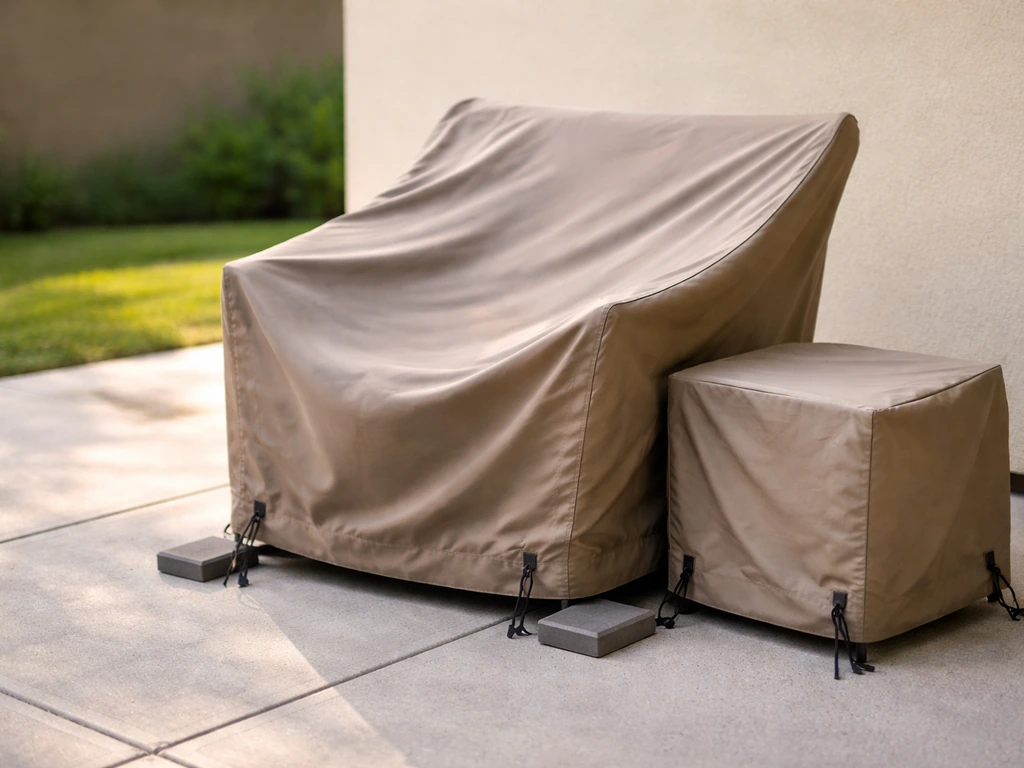
On concrete or pavers, weighted bases and floor anchor bolts are your best bet. On a deck, strap furniture to the railing or use non-slip pads plus furniture weights. For covers, an elastic hem cord plus buckle straps at the legs is the combination that actually holds in real wind. No single trick works for everything, so the key is diagnosing what's actually happening first, then layering your solutions.
Start here: what's actually happening with your furniture
Before you buy anything or start drilling holes, spend two minutes figuring out exactly what your wind problem looks like. There are three distinct scenarios, and they need different fixes.
- The cover is blowing off but the furniture stays put. This is a cover fit and fastening problem, not a furniture anchoring problem.
- The furniture is sliding or skidding across the patio. This is a friction and weight problem. The furniture is too light or the surface is too slick.
- The furniture is tipping over. This is a stability and center-of-gravity problem, most common with tall chairs, loungers, and open-frame pieces.
- The whole setup (furniture plus cover) is tumbling or sailing off together. This is a serious wind event and you need anchoring plus weighting, not just straps.
Wind type matters too. Occasional gusts under 30 mph are manageable with basic strapping and weight. Sustained high winds above 40 to 50 mph, or storm-level events, are a different story. At that point, even a correctly strapped cover can act like a sail and amplify the lift forces on your furniture. IBHS research on porch covers and carport structures confirms that wind uplift is the key failure mechanism, and that poor connections are what cause things to actually detach and fly. So your goal is always to reduce the sail effect of covers and increase the connection strength between furniture and ground.
Also check your surface before you look at solutions. Dirt and grass allow stakes and auger anchors. Concrete and pavers support bolt-in floor anchors or fillable weighted bases. A wood deck means you can screw in anchor points without losing your deposit (if you own the home). Renters or anyone on a no-drill restriction needs to think weights, straps to existing railings, and non-penetrating options. Write down your surface and your scenario before moving to the next section.
How to keep your patio furniture cover from blowing away
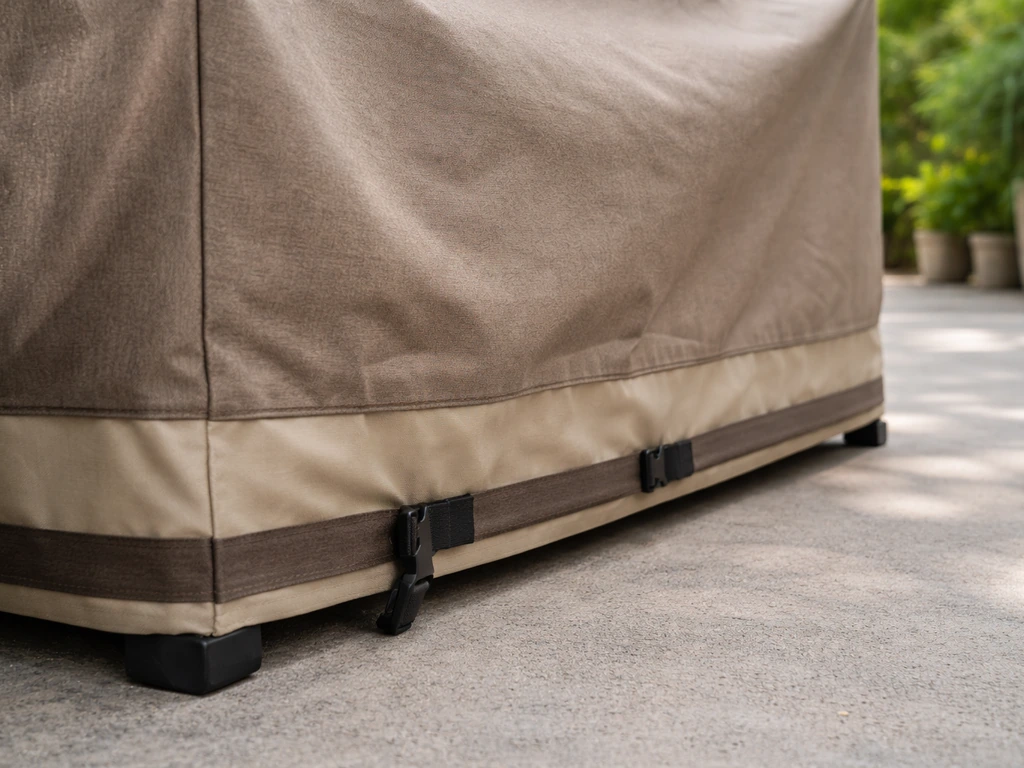
A cover that blows off in every storm is one of the most frustrating patio problems, mostly because it seems like it should be simple. If the cover fix alone does not hold, follow up by anchoring the furniture itself as well using the same strap and anchor approach described in How to keep the furniture itself from blowing away. Here's why it keeps happening: the cover is either the wrong size, missing proper fasteners, or both. Fix the fit first, then add fasteners.
Get the fit right first
A cover that's even a few inches too large will catch wind like a parachute. The hem will lift, air will get underneath, and the whole thing will billow up and off. If your cover is baggy anywhere along the sides or bottom, that's your core problem. You want a cover that fits snugly around the profile of the furniture with minimal excess fabric pooling at the base. If you're buying new, measure the length, width, and height of your piece and match the cover dimensions as closely as possible. Don't buy up a size "just to be safe" because it will hurt you in wind.
Elastic hems and buckle straps: the combination that works
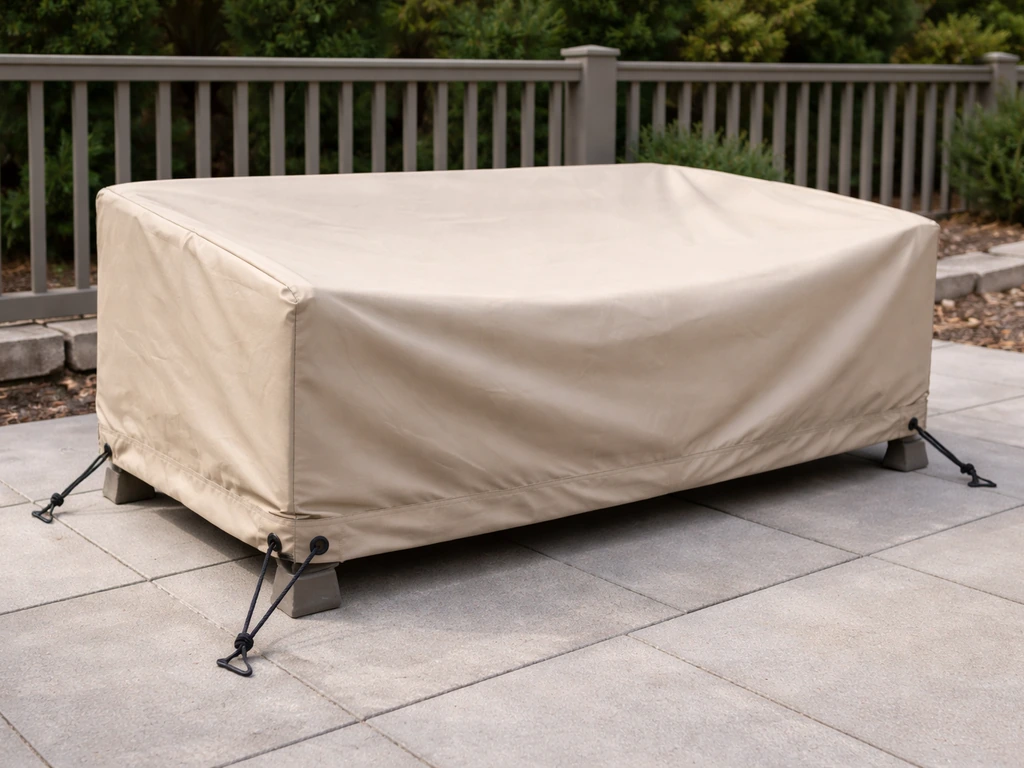
Good covers have two built-in features worth understanding. First is an elastic cord sewn into the bottom hem, which cinches the cover snugly under the furniture base and cuts the air gap that lets wind get underneath.
Second is buckle straps, which wrap around the furniture frame and click or ratchet tight. Classic Accessories and Creative Covers both build these into their products for exactly this reason. Creative Covers specifically notes that buckle straps are better for high-wind areas than elastic alone. If your current cover only has elastic and it keeps blowing off, adding buckle straps is the upgrade you need.
Lowe’s product listings for patio furniture covers include click-close leg straps that are designed to secure the cover in place buckle straps.
How to strap a cover correctly
- Pull the cover down over the furniture and cinch the elastic hem cord as tight as it goes. Make sure there's no gap between the hem and the base of the furniture on any side.
- Thread one strap around the outside of the furniture frame near the bottom, keeping it below any armrests or crossbars so it can't ride up.
- Keep tension on the strap the entire time you're wrapping it. The Patio Direct installation guide makes this the single most important step: if you go slack for even a second, the strap will loosen when you let go.
- Buckle or clip the strap and pull the free end to tighten. It should feel firmly snug, not just hand-tight.
- If the cover has grommets along the hem, thread a bungee cord or zip tie through each grommet and hook or tie it to a furniture leg. This is your backup layer.
- For large sets or sectionals, install a strap at each corner of the piece. One center strap on a large sectional is not enough.
No built-in straps? DIY options that actually work
If your cover has no straps, you have a few good options. Bungee cords hooked through the hem grommets and wrapped under furniture legs work well for moderate wind. Coverstore recommends using safety clamps slipped over the cover hem after placement as an extra retention layer. A drawstring-style cord threaded through the grommets pulls the hem tighter with less friction than pocket-style covers, which is why ALC Covers uses that approach on their designs. For genuinely windy areas, you can buy aftermarket buckle straps at any hardware store and loop them through existing grommets. Check with your cover manufacturer for the correct strap width, since a too-thin strap can tear a grommet hole under load.
How to keep the furniture itself from blowing away
Light aluminum chairs and resin furniture are the biggest offenders here. They look sturdy but weigh almost nothing, and a 40 mph gust treats them like toys. The fix depends on whether you need to anchor to the ground or just increase mass.
Anchoring by surface type
| Surface | Best Anchor Method | No-Drill Alternative | Estimated Cost |
|---|---|---|---|
| Dirt or grass | Auger (mobile home style) anchors with cable or strap to furniture legs | Sandbag weights placed on base rungs | $15–$40 for auger kit |
| Concrete slab | Wedge anchor bolts to floor plates, strap furniture legs to plates | Fillable weighted bases (sand or water) | $20–$60 for anchor hardware |
| Pavers over sand/dirt | Anchor through pavers into concrete sub-base, or bypass pavers entirely with auger into soil between pavers | Fillable weighted bases | $30–$80 depending on depth |
| Wood deck | Screw-in eye bolts into deck joists, strap furniture to them | Clamp-style rail straps to deck railing | $10–$30 for hardware |
Senmit's anchoring guidance makes an important point about pavers: decorative pavers are not a reliable anchor point on their own. If you're trying to bolt or stake into a paver patio, you need to reach the concrete sub-base underneath, or use the gaps between pavers to sink an auger into the soil below. Don't just screw into the paver surface and call it done.
Auger anchors: the strongest option for ground installations
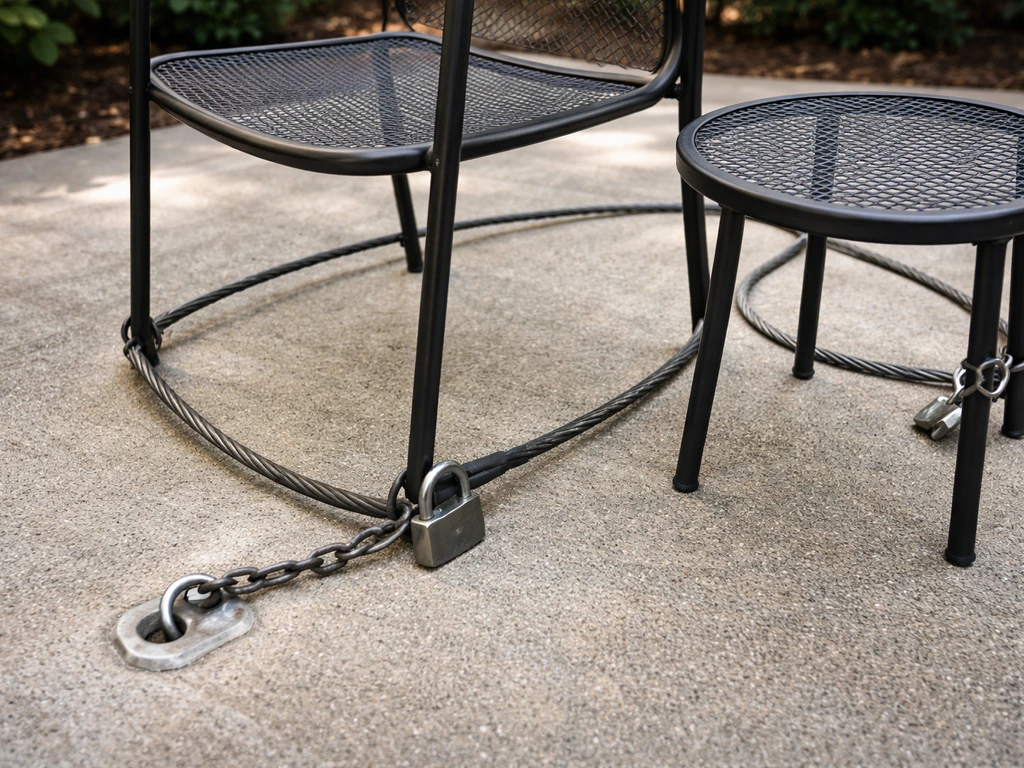
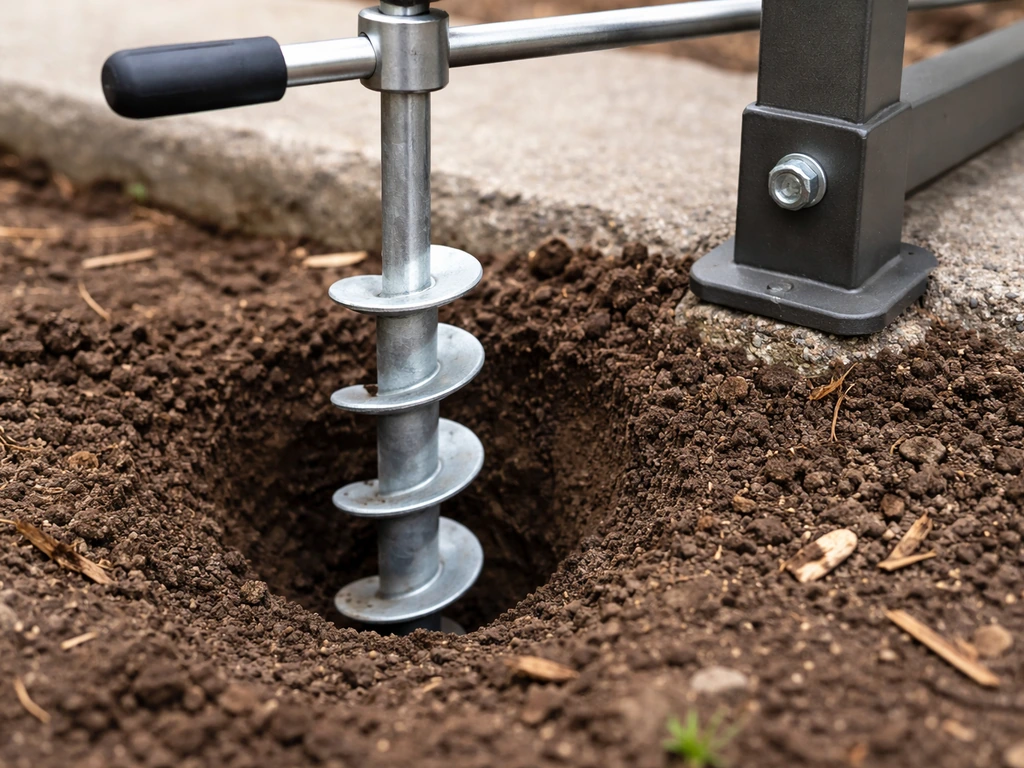
An auger anchor looks like a giant metal corkscrew. You twist it into the ground by hand or with a drill attachment, and it resists pull-out forces far better than a straight spike because the helical shape locks into soil. Get Carports specifically recommends mobile home-style auger anchors as the go-to choice for dirt and grass surfaces. Once the auger is in, you attach a cable or tie-down strap from its eyelet to a furniture leg. For loose or sandy soil, ALCO and Engineer Fix both recommend setting the auger in a small puddle of concrete for added hold. That extra step costs almost nothing but dramatically increases pull-out resistance in a bad storm.
Weighted bases: the renter-friendly option
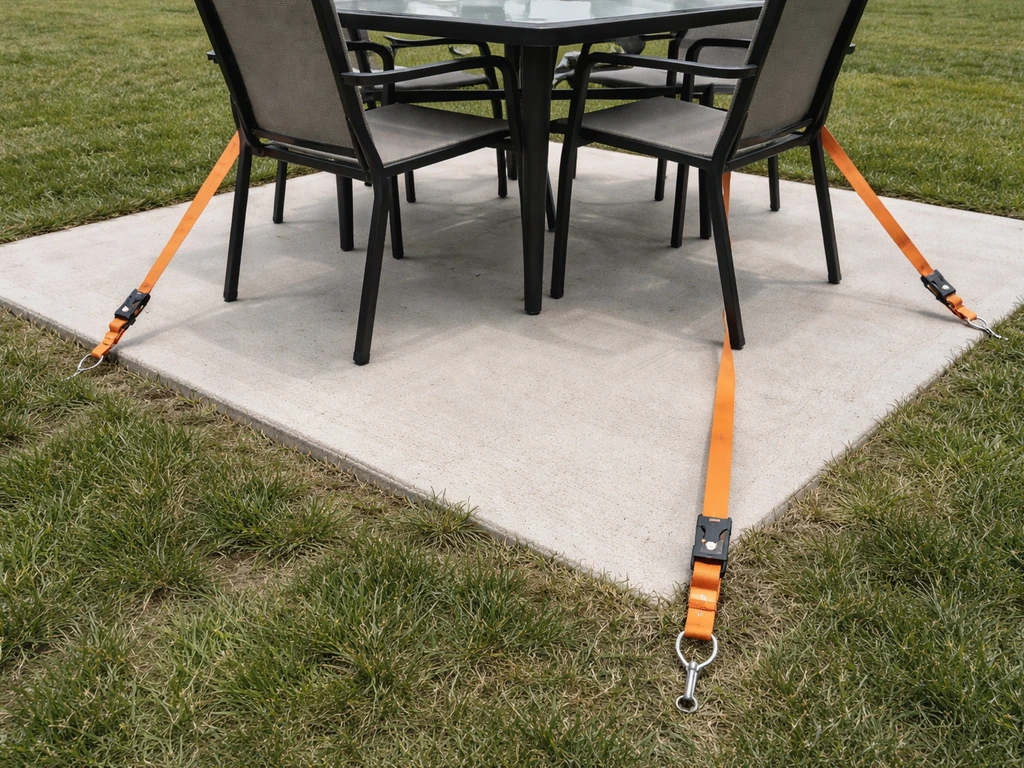
If you can't anchor into anything, weight is your next tool. Fillable umbrella bases that accept sand, water, or even concrete are the classic example, but the same logic applies to furniture bases, chair bags, and strap-on weights. Sand is heavier than water per volume, so always fill with sand if you have the choice. Engineer Fix notes that a low center of gravity matters just as much as raw weight, so place the ballast low on the furniture rather than strapping it to the top. A 50-pound sandbag draped over a chair seat does almost nothing for tipping resistance; the same bag hung from the bottom rung of the chair is significantly more effective.
Tie-down straps: connecting furniture to anchor points
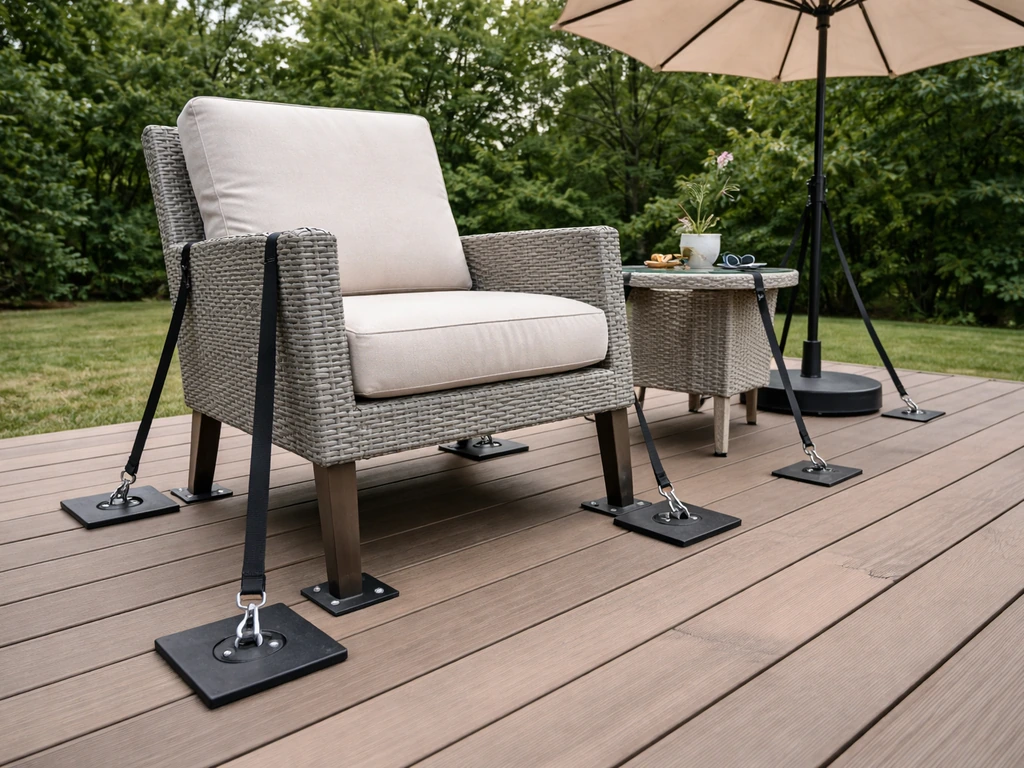
Once you have an anchor point (auger, floor plate, railing, or adjacent heavy object), you need a strap to connect it to the furniture. Ratchet straps give you the most adjustable tension and are available at any hardware store for around $10 to $20. Nite Ize CamJam straps are a popular compact option with a working load limit of 700 pounds and a break strength of 2,100 pounds, which is more than enough for most patio furniture. For permanent installations, House of Tents recommends ratchet tensioners specifically because they let you re-tighten after the strap stretches or settles. Check your straps at the start of every outdoor season and re-tension if needed.
How to keep furniture from tipping over (not just blowing away)
Tipping and flying away are related but not the same problem. A chair that tips over in wind is usually doing so because it has a high center of gravity and a narrow base footprint, not because it's too light to stay put. The fix is about geometry and friction as much as weight.
Chairs and loungers
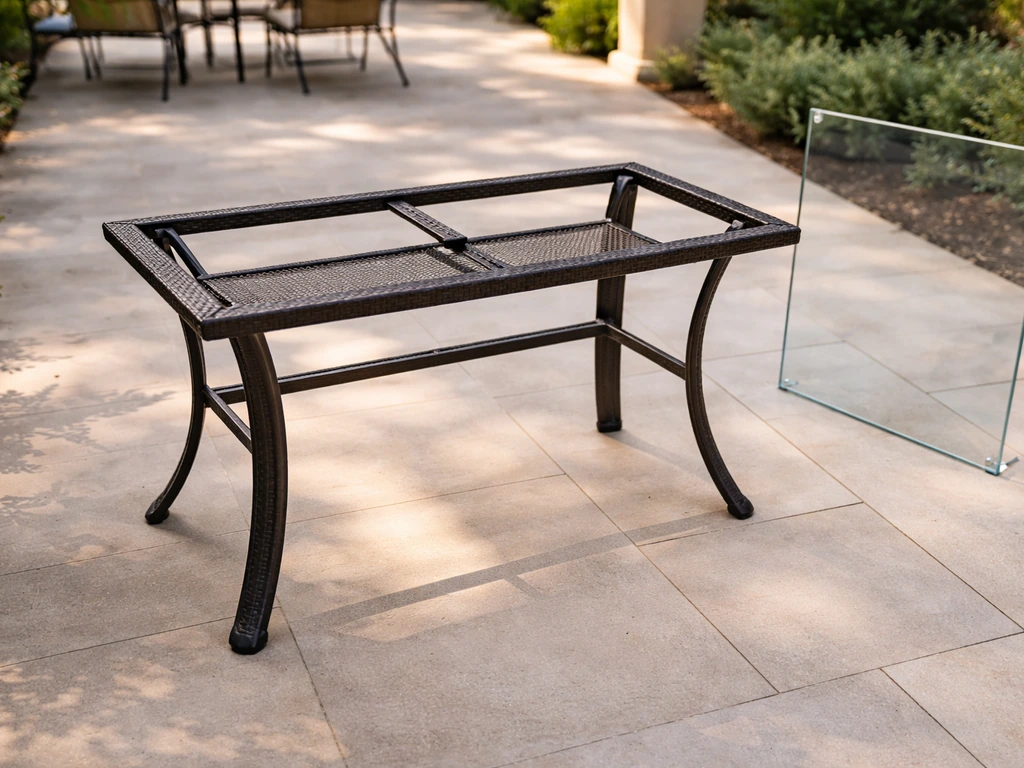
High-back chairs are the most common tippers because the back acts like a sail and the pivot point is at the rear legs. Two things help: non-slip rubber feet or pads on each leg (these grip the surface and slow the initial tip) and lowering the chair back if it's adjustable. Adirondack chairs and sling chairs with reclined backs are especially vulnerable. If your chairs keep tipping backward, try stacking them when not in use, or turning them face-down against the patio surface during high-wind warnings. It sounds obvious but it works, and it's faster than any strap setup.
Tables
Glass-topped tables are the highest-risk piece on most patios, both for tipping and for catastrophic damage if they do go over. Remove the glass and store it indoors any time winds are forecast above 35 mph. For the table base, a strap from each leg to a floor anchor following ShelterLogic's one-anchor-per-leg principle gives you the most even resistance to tipping in any wind direction. If you can't anchor the legs, place the heaviest items you own (a plant pot, a bag of sand, a concrete block) on the base shelf underneath the table surface, as low as possible.
Umbrellas and swings
Patio umbrellas should be closed and lowered any time you're not sitting under them. Even a closed umbrella pole in a light-weight base can tip in a sustained gust. If your base isn't heavy enough, upgrade to a fillable base and fill it with sand rather than water. For patio swings, the structure itself can tip or shift, and the approach there is similar to anchoring a canopy: one anchor per leg, run to the ground, with enough tension to resist lateral load. This same one-anchor-per-leg idea also works well for a patio swing, helping prevent it from blowing over in strong winds one anchor per leg.
Step-by-step DIY setup by furniture type and budget
Here's how to actually set this up today, matched to common furniture types. I've organized by budget because that's usually the real constraint.
Under $20: basic strap and weight setup
- Buy a two-pack of ratchet straps (10 to 15 feet each) from a hardware store or online. Around $12 to $15.
- Fill any hollow furniture bases or legs with sand using a funnel and a bag of play sand ($5 at a home center). Even a pound or two of added weight makes a meaningful difference in light aluminum pieces.
- Place rubber shelf liner or non-slip rug pads under each furniture leg. Cut to size if needed. This adds friction with zero drilling.
- For covers: cinch the elastic hem cord as tight as it goes, then run one ratchet strap around the outside of the piece at leg level. Tighten until you feel firm resistance.
- Store chairs face-down or stacked when wind is forecast and you won't be outside.
$20–$60: ground anchor setup for dirt or grass
- Buy a set of auger anchors (the helical spike type, often sold as mobile home or tent anchors). A four-pack runs about $20 to $35.
- Twist one anchor into the ground at each corner of your furniture grouping, angled slightly away from the furniture. Go at least 12 inches deep.
- Run a ratchet strap or cable from each anchor eyelet up and around the nearest furniture leg.
- Tighten each strap until the furniture has minimal movement. Test by pushing the piece firmly from each direction.
- For loose or sandy soil: pour a small amount of mixed concrete around each auger before it sets, then re-check tension after 24 hours.
$40–$100: concrete or paver patio anchoring
- Buy flush-mount or surface-mount floor anchor plates and matching wedge anchor bolts. Check that the working load limit is rated for at least the weight of your furniture plus expected wind load.
- If on pavers, locate the concrete sub-base underneath (usually 3 to 4 inches down). Rent or borrow a hammer drill with a masonry bit.
- Drill pilot holes through the paver and into the concrete sub-base. Set the wedge anchor bolts and tighten until the plate is firm against the surface.
- Attach ratchet straps from the floor plates to your furniture legs. Run one per leg for full stability.
- For covers with grommets: thread a snap hook through each grommet and connect to the floor plate anchor for an additional hold point.
No-drill renter setup (any budget)
- Use fillable weighted bases for umbrella poles and any tall freestanding pieces. Fill with sand, not water.
- Strap furniture legs together as a group using ratchet straps run horizontally around the whole set. A grouped set is harder to move than individual pieces.
- Run straps from furniture legs to deck railings, fence posts, or any fixed structure. Use padded hooks or strap protectors to avoid scratching the railing finish.
- Lay non-slip pads under every leg. Combine with the strapping for best results.
- For covers: use aftermarket buckle straps through existing grommets. ALCO Custom Covers recommends using GroundGrabba-type ground spikes with snap hooks through grommets if you have any soil access.
Seasonal habits that keep everything secure long-term
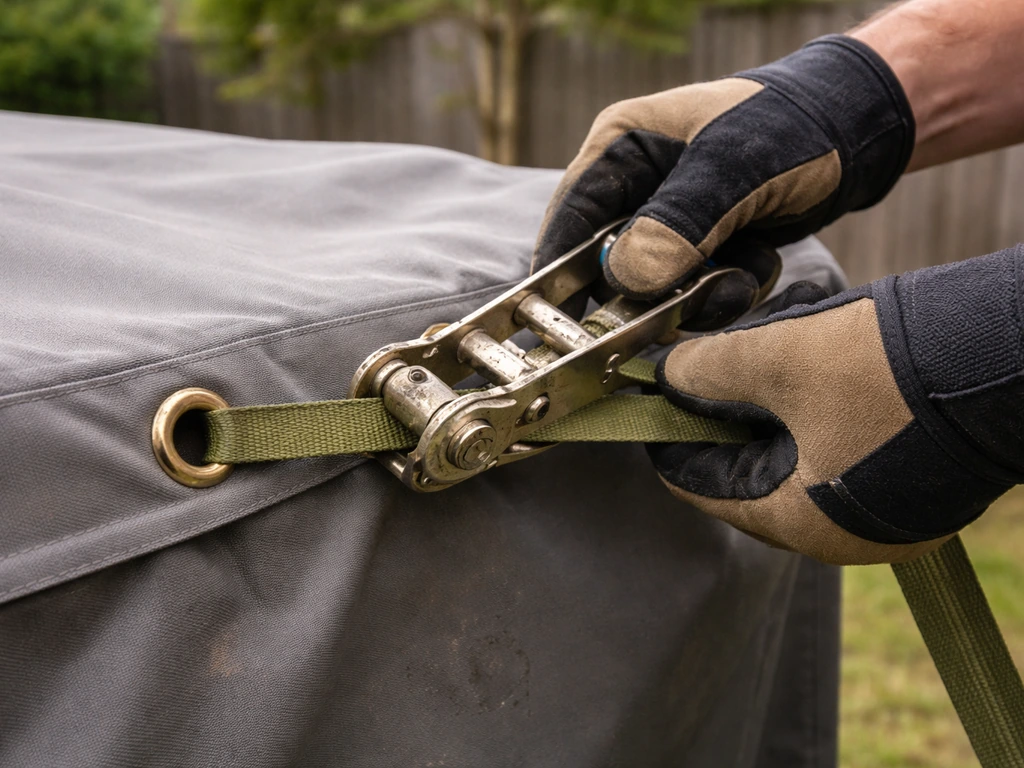
Setting up wind protection once is a good start, but the real reason things fail is that straps stretch, anchors loosen, and covers degrade over a full outdoor season. Here's the maintenance rhythm that actually keeps things working year after year.
At the start of each outdoor season (spring)
- Re-tighten all ratchet straps and anchor connections. Straps settle over winter, and a strap that was tight in October will be loose by April.
- Inspect grommet holes on covers for tearing or deformation. A grommet that's pulled out is a cover that will fly away. Replace grommets with a grommet kit (under $10) or replace the cover.
- Check elastic hem cords for cracking or loss of stretch. UV exposure degrades elastic over one to two seasons. If the cord isn't snapping back firmly, replace it.
- Test auger anchors by pulling up on the attached strap. If the anchor shifts or pulls up easily, re-sink it and consider adding concrete around the base.
- Check strap width against cover manufacturer specs to make sure you're using the right size for your grommet diameter.
During the season: before wind events
- Close and lower any patio umbrellas before storms. This is the single highest-impact step for umbrella safety.
- Remove glass table tops and store them inside for any forecast above 35 mph sustained winds.
- Stack or invert lightweight chairs against a wall or fence so they can't catch wind.
- If you have a patio furniture cover on a piece you're not using, make sure all straps are tight and grommets are connected before rain and wind arrive together.
- Bring in decorative cushions and pillows. They become projectiles in high wind and aren't designed to anchor furniture anyway.
End of season (fall)
- If you're covering furniture for winter storage, use the buckle strap method rather than elastic-only, since winter storms can bring the highest wind loads of the year.
- Release and coil ratchet straps before storing so the mechanism doesn't freeze or corrode.
- If furniture is going into a shed or garage, that's your best wind defense. No anchor system beats being indoors.
- Inspect cover materials for UV degradation, cracking, or seam separation before you rely on them for another winter. A cover that looks fine in October may not hold up through February.
- Document your anchor point locations (a quick photo works) so you're not hunting for buried augers next spring.
One more thing worth knowing: covers, chairs, cushions, and rugs all have slightly different wind-failure modes. Because covers and furniture hardware are only part of the equation, it helps to use rug-specific anchoring so your patio rugs stay put in gusts. The techniques for keeping cushions or rugs in place overlap with what's covered here but have their own specific fixes. The same is true for patio swings, which need structural anchoring at all four contact points to stay safe in wind. Once you have your furniture secured, those are the next logical pieces to address in your overall patio wind-protection setup.
FAQ
My cover has elastic but still blows off. Should I add more weight or change the strap system?
If your cover is blowing off, treat it as two problems: first reduce the sail effect (fit plus hem cinch or elastic), then add positive retention (buckles, safety clamps, or straps to anchor points). If you only add weight to the furniture without improving the cover fit, the cover can still catch wind and lift the entire setup.
Can I just use bungee cords to keep the cover from blowing off in high wind?
For gusty conditions, avoid relying on bungee cords alone. They stretch and can loosen after a few wind cycles, so use them as a temporary option. For reliable retention, upgrade to buckle straps or add ratchet straps from the cover or furniture to an anchor point.
How do I know if my straps are tied to the right parts of the furniture?
Dress the straps so they connect to structural points, not flimsy trim or decorative sections. A strap can feel tight but still fail if it rubs, cuts, or detaches from a weak frame member, so pull-test lightly after installation and re-check after the first windy day.
Will the strap placement affect whether a chair tips versus flies away?
Yes, and it matters. If you connect a strap to the wrong height on the furniture, you can increase tipping rather than prevent it, especially with high-back chairs and tables. For tipping resistance, aim for lower connection points and one connection per leg where possible.
How can I tell whether my cover problem is a fit issue or an anchoring issue?
Take a quick “failure-mode” look after a near-miss. If the cover lifts but the furniture stays, fix the cover fit and retention first. If both move, add anchors and strap connections for the furniture itself, then revisit the cover straps as a second layer.
What’s the risk of buying a cover “a size up” for easy fit?
Many people oversize the cover, and that increases billowing, especially at the hem. If you already bought a cover too large, reduce the air gap using hem cinch, buckle straps at the legs, or safety clamps, then consider replacing it with the correctly sized option.
How often should I inspect and re-tighten straps and anchors?
Because links stretch and weather changes the cover and frame, a one-time setup often fails mid-season. Do a short check at the start of the season, after any storm with strong gusts, and midway through if you’re in a high-wind area.
Can I anchor directly into pavers and skip the sub-base?
For paver patios, never assume decorative pavers are strong enough for stakes or bolt-in anchors on their own. Either use the gaps to reach soil with an auger, or anchor into the concrete sub-base if your layout allows it.
What are my options if I cannot drill, stake, or use floor anchors?
If you cannot reach a stable anchor point (like no-drill rules or no railing access), use a combination of low-profile ballast and furniture-to-adjacent-object ties. Prioritize weights that sit low (bottom rung or base shelf) and strap to something immovable rather than relying on the bag/bottom cover alone.
My chairs are tipping backward in wind. What should I try first besides adding weight?
If a chair keeps sliding or tipping, it can be more about friction and center of gravity than total weight. Add non-slip pads to every leg, lower the back if adjustable, and consider temporarily turning or stacking the chairs during windy warnings.
Do I need to secure glass-topped tables differently during storms?
Glass-topped tables are a special case. When winds are forecast above about the mid-30s mph, remove the glass and store it indoors, then strap each leg to a floor anchor with a one-per-leg approach to reduce tipping and lateral shift.
Can a closed patio umbrella still blow over in wind?
For umbrellas, wind load can tip even when closed, because the pole acts like a lever. If your base is fillable, use sand and keep the umbrella down when not in use, then upgrade the base size if it wobbles in moderate gusts.
Is one anchor enough to stop a swing or table from moving in strong wind?
A “single anchor” can leave the furniture rotating under lateral force. Where you can, connect each leg (or each contact point) to an anchor, then tension so the furniture cannot move in any wind direction.